
Hawaii Release Status Explained
A Hawaii custody record answers more than a yes-or-no question. The Hawaiʻi Department of Corrections and Rehabilitation, officially known as DCR, operates both the state prison layer and four community correctional centers that perform island jail functions. Police departments also keep short-term holding records. A person can leave one of those places for the community, a courtroom, another DCR site, parole, a furlough setting, a hospital, federal custody, immigration custody, or another lawful authority. Each event ends one placement, but only some are community releases.
The legal reason and the physical move should be checked apart. A bail order, dismissal, sentence, or parole decision shows authority for an outcome. DCR's release documentation and final custody entry show how staff carried it out. A live roster is designed to show present custody, so it may cease to display a person after departure. That absence alone does not establish where the person went. The next record should identify the release type, destination category, or receiving authority when that information is public.
| Release or movement | What it means | Best record trail |
|---|---|---|
| Bail, dismissal, or time served | The local custody episode can end by court authority. | Court docket plus DCR or police release record |
| Parole | Conditional community release while the sentence continues. | HPA decision, DCR departure record, and SAVIN status |
| Furlough or pre-release placement | Movement into a program while DCR may retain legal authority. | DCR movement record and current status |
| Transfer or detainer | One custodian releases the person to another. | Sending record plus the receiving agency locator |
| Final discharge | The sentence or parole authority ends under the governing order. | DCR record, HPA discharge, or court order |
Note: “Released from a facility” should not be restated as “free in the community” unless the destination record supports that conclusion.
Hawaii Release Record Fields
DCR procedure COR.16.02 shows why an operational record is more useful than a bare online status. Staff verify identity and the legal release document, check other charges and holds, account for property and money, complete the release paperwork, and update Offendertrak. DCR 8219 is identified as the Release Checklist, and DCR 8281 is a Release Status Form. A focused request should ask for existing records and named fields instead of asking the agency to write a new account of what happened.
| Field | What it can establish |
|---|---|
| Full name and DCR number | Which person and correctional record were matched |
| Admitting and releasing facility | Where the custody episode began and ended |
| Admission and departure date or time | The recorded custody interval and executed event |
| Release type or disposition code | Whether the event was release, parole, transfer, furlough, court discharge, or another result |
| Supporting authority | The court paper, HPA action, or other legal basis used by staff |
| Receiving authority or destination class | Whether custody continued with another agency |
| Hold resolution | Whether another charge or detainer affected departure |
| Final Offendertrak entry | The correctional status entered after processing |
Sensitive personal, medical, victim, sponsor, security, and identifier details may be withheld. That does not always justify withholding the entire record. A request can ask DCR to redact exempt data and provide the reasonably segregable public portions. For older events, this maintained file and the related court docket are more dependable than guessing from a missing result in a current public interface.
Request Hawaii Release Records
Hawaii's Uniform Information Practices Act (Modified), HRS chapter 92F, governs access to state and local agency records. Section 92F-11 sets disclosure duties, while section 92F-13 covers exceptions such as a clearly unwarranted invasion of privacy or harm to a legitimate government function. The Office of Information Practices provides a model Request to Access a Government Record. Send it to the office that maintains the custody episode, which may be DCR, a police department, HPA, or a court.
The Office of Information Practices request-forms page shows the statewide starting point for a written request.
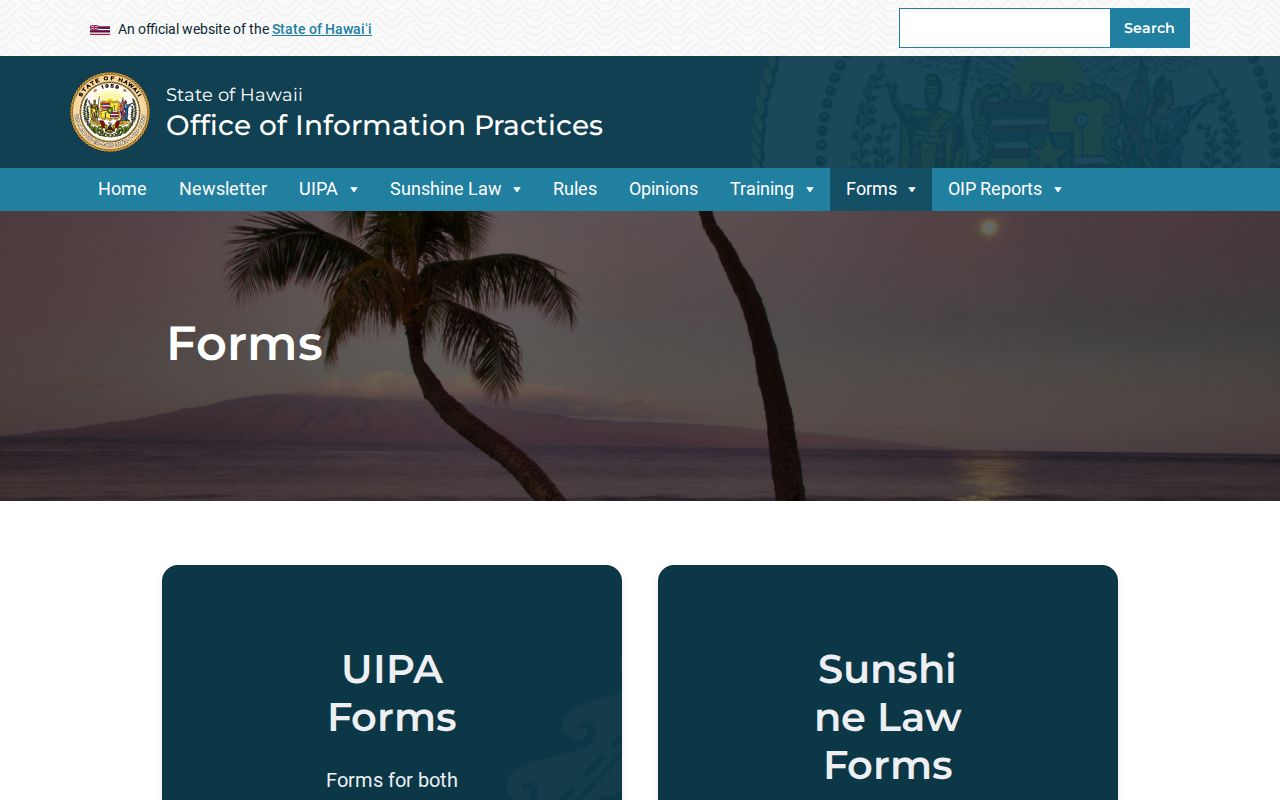
The form supports a precise request for an existing release checklist, status form, movement entry, or sentence calculation instead of a broad request for every file.
- Name the person and add a DCR, booking, or case number if known.
- State the facility and a useful admission or release date range.
- List the exact records or fields sought, including actual departure, disposition, authority, destination, final status, and sentence computation.
- Ask for electronic copies, a fee estimate, and reasonably segregable nonexempt portions.
- Keep the agency response and any cited exemption with the record set.
OIP guidance generally calls for an agency response within ten business days, with extended procedures when extenuating circumstances apply. A response may be an acknowledgment or notice rather than the completed production. Search, review, segregation, copying, and delivery can affect cost, so no single flat statewide fee should be assumed. Current OIP guidance and the maintaining office's estimate control.
Note: A narrow request for named forms and fields is easier to route and separates public data from protected material.
Hawaii Release Law Boundaries
Public access does not make every part of a release file public. HRS chapter 92F permits agencies to protect qualifying private or operational material. Juvenile, sealed, expunged, and otherwise confidential records need separate treatment. When a request is denied in whole or part, ask for the specific legal basis and for the rest of the record after redaction. Personal-record access and correction rights appear in sections 92F-21 through 92F-25, but those provisions serve a different role from a general public request.
Records rule: Ask for the record that exists, invite lawful redaction, and do not treat an online no-result as proof that the underlying agency file was erased.
Booking photographs also depend on disposition and the record holder. OIP Opinion 94-12 found an HPD post-conviction mugshot available under UIPA. OIP Opinion 03-09 explains that expunged arrest photographs are confidential and discusses older photos when no disposition is recorded. The research found no enacted Hawaii law that creates a statewide mugshot gallery or a specific anti-pay-to-remove rule. A 2024 bill proposed commercial restrictions, but a proposal is not current law.
Sealing, expungement, and deletion from a public portal are not the same act. An agency applies the current law to its maintained copy. A court order can change access to court material without proving that every other lawful copy has vanished. For that reason, release verification should rely on the official record currently available from the office that created it.
Hawaii Courtroom Release Trail
Hawaii has a notable release-location rule. Under DCR COR.16.02, a person acquitted in court, whose case is dismissed, or whose charge ends by nolle prosequi is released forthwith at court when no other hold exists. Staff do not first take that person back to the correctional facility merely to release them there. Property may be retrieved later. The physical exit can therefore be the courthouse, not a jail or prison gate.
The DCR home page identifies the statewide agency and its official custody-locator route.
This agency context matters because a court order and DCR's executed status record answer different parts of the same release question.
A court entry supplies the legal basis. DCR or police paperwork establishes how the custody episode ended and whether another hold changed the result. When property is picked up later, that later visit is not a second custody release. Ask for the court disposition, actual release date and time, the hold check, and the final status rather than inferring the full event from the place where the person was last seen.
Find Hawaii Released Inmates
The best statewide path starts with jurisdiction. DCR custody and parole status use Hawaiʻi SAVIN/VINELink. Police-only holding calls for the police record and court docket. Federal prison custody uses the Bureau of Prisons locator. Immigration detention uses ICE's locator. If an online result is missing or too brief, the maintaining agency's release or movement record is the fallback. A former name on a roster should not be treated as current proof, and disappearance from that roster should not be treated as discharge.
- Identify the arresting or correctional agency, facility, court case, and approximate date.
- Search Hawaiʻi SAVIN for a DCR custody or parole record and preserve the exact label shown.
- Check eCourt Kōkua for the order, judgment, sentence, probation action, or dismissal behind the event.
- Use the correct local route for a police cellblock record or island custody question.
- Continue with BOP or ICE when a federal agency may have received the person.
- Request the maintained release or movement record when the portals do not settle the question.
The direct Hawaii VINELink person search is DCR's official public person-search destination.
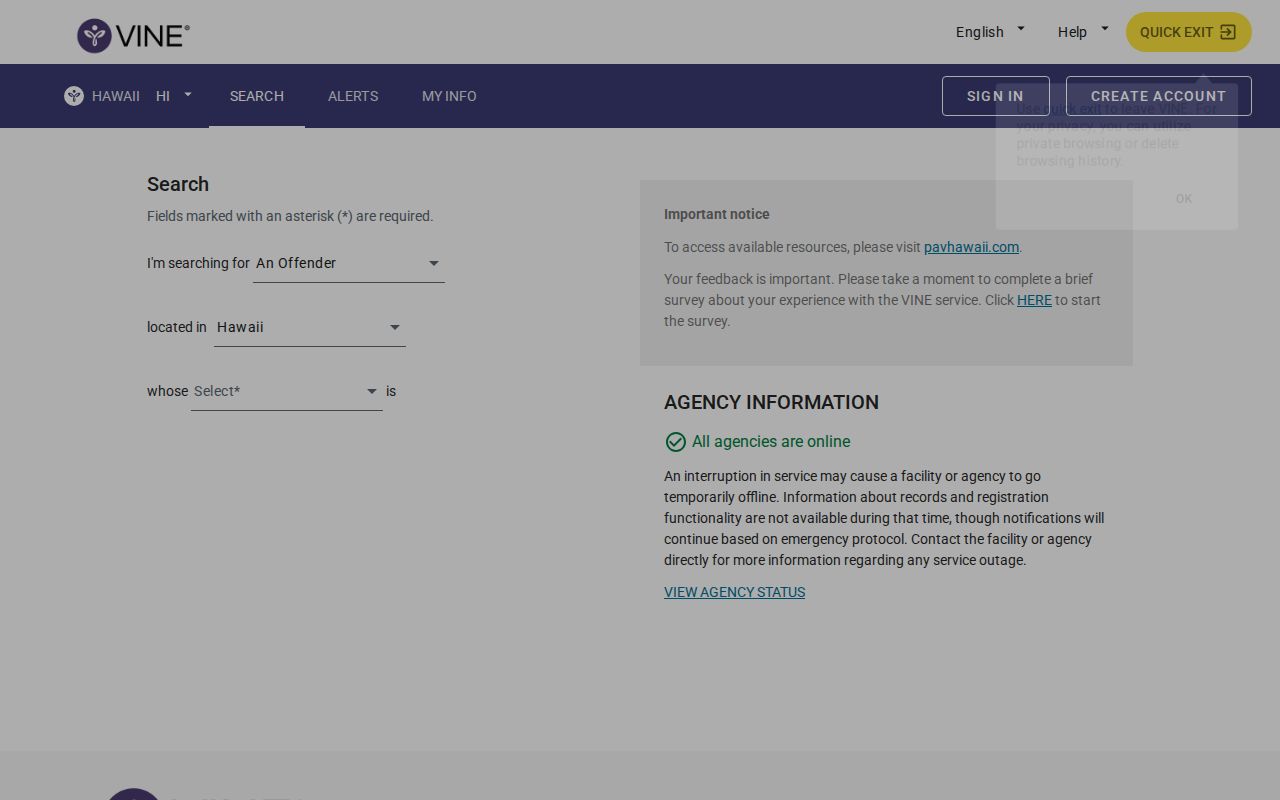
The result must be read literally, since release, transfer, parole, and out-of-custody wording should not be silently converted into one another.
Important: A missing live result is not a discharge record. Check spelling, identifiers, other jurisdictions, the court, and the responsible records office.
DCR Hawaii Release Search
DCR does not publish a separate historical offender-profile database like the locator used in some states. Its official “Locate an Offender” path is Hawaiʻi SAVIN/VINELink. The system offers custody and parole information for offenders under DCR jurisdiction and supports release-event notices, but DCR does not promise that every former offender remains searchable for a fixed time. This makes it a first check, not a complete historical archive.
For a deeper account of the system, the DCR offender search page explains how to preserve a result and request the underlying departure record.
Search by the live name or identifier fields, retaining punctuation, ʻokina, spaces, aliases, and multiple surnames. Compare neutral identifiers to avoid merging people with similar names. Open the matching record and note the exact status, agency, facility, event date, and check time. If parole appears, seek the HPA action too. If nothing appears, consider older custody, police-only custody, federal or immigration custody, another state, or an interface gap.
The official Hawaii person-search interface also serves as the starting point for notification registration.
Its public screen documents the search channel, while the DCR release checklist and Offendertrak entry remain the stronger operational evidence.
- Release
- An executed departure event, which may still lead to another custodian.
- Parole
- Conditional community release while HPA authority and sentence terms remain.
- Discharge
- The formal end of the relevant custody or supervision authority.
- Detainer
- A hold or request that may route a person to another agency.
Hawaii Parole Release Measures
HPA's reports separate parole decisions from completed releases. In FY2023, the authority recorded 1,685 parole-consideration hearings, 1,277 people considered, 447 grants, 1,058 denials, and 180 deferrals or continuances. The same series lists 2,431 hearings and 900 grants in FY2021, then 1,861 hearings and 528 grants in FY2022. Hearings and grants fell across those three fiscal years, but the numbers alone do not prove why.
The DCR annual-report index provides dated statewide reports that should be kept separate from live custody status.
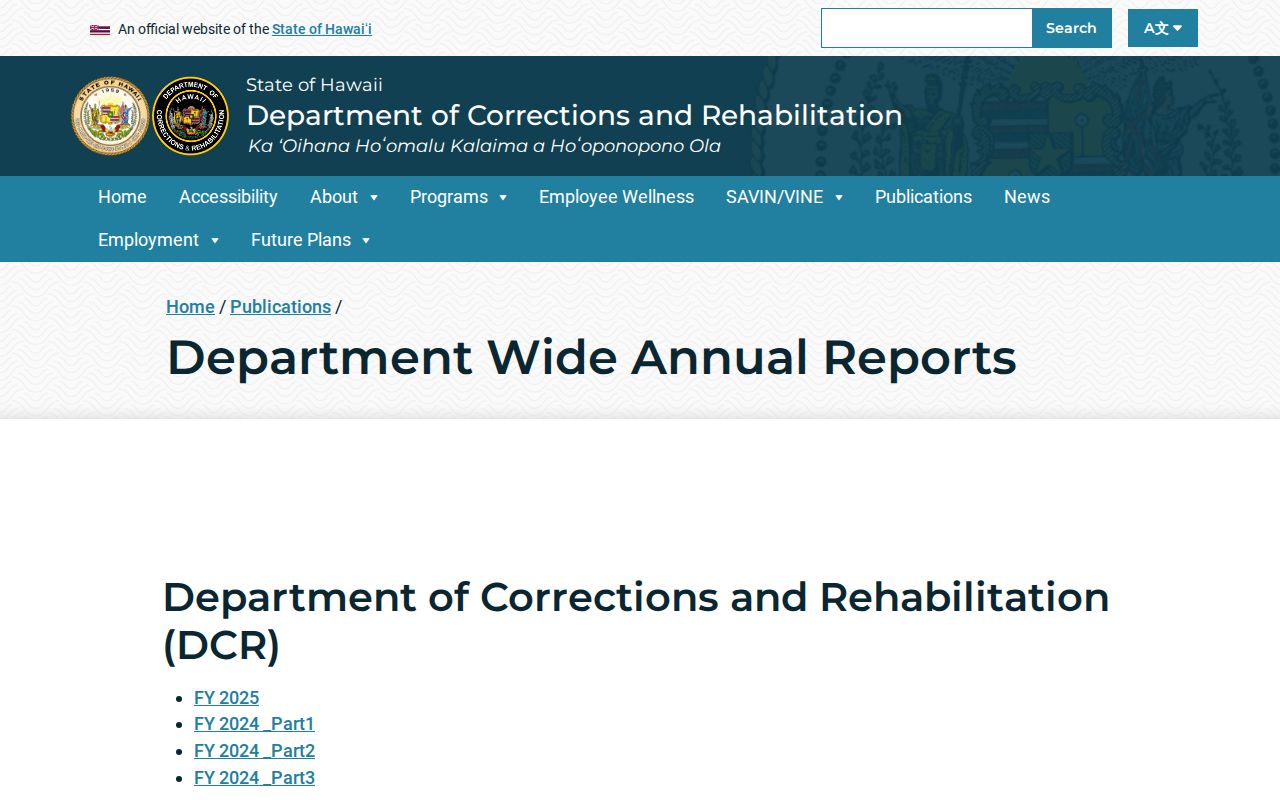
Each figure needs its fiscal-year label because hearing outcomes, parole caseload, prison population, and actual departures measure different things.
A state variance report dated December 3, 2024, gives FY2023-24 actuals of 997 parolees under Hawaii jurisdiction, 1,175 minimum sentences fixed, 1,537 people considered at minimum expiration, 439 paroles granted, 895 denied, 189 revoked, and 36 parolees reviewed for discharge. It reports a 38 percent grant rate at minimum expiration and an average six years on parole before final discharge. Those are agency-labeled actuals. Estimate columns for a later fiscal year should not replace them.
Does a parole grant prove release? No. HPA separately counts grants and actual releases because plan approval, processing, a detainer, or another event can stand between the decision and physical departure.
Note: Always preserve the fiscal year and measure name when citing a parole statistic, since one person can have more than one hearing.
Hawaii Court Release Records
eCourt Kōkua is the statewide case-information gateway for Hawaii courts. It can retain bail and release orders, dismissals, judgments, sentences, probation orders, revocations, and later docket events after a person disappears from a live custody search. A docket entry does not itself prove the exact moment DCR or police executed an order, but it often supplies the missing legal reason for the change.
Older migrated case numbers can require reconstruction. The Judiciary's access guidance says the old identifier may need a one-digit circuit, case type, and leading zeroes to make a twelve-character number. A PDF icon signals that a public document is available online. Sealed, confidential, and some older material must be requested from the court or may not be public. Public terminals and hard-copy requests are the fallback.
The state government-record forms offer a separate path for maintained agency records when the court portal does not contain the executed release detail.
The key is to request from the record holder: the court for its order, DCR for correctional processing, or police for a cellblock release.
Hawaii Local Release Routes
Hawaii does not follow the usual model of a county sheriff running each county jail. DCR operates HCCC, KCCC, MCCC, and OCCC as community correctional centers, and WCCC also performs an Oʻahu jail function for women. Police departments maintain separate short-term cellblock and arrest records. The first local question is therefore which agency held the person, not merely which county appears on the case.
The Hawaii County Directory routes a search to the five locality sites and their documented police, DCR, court, and records paths.
The DCR correctional institutions page shows the statewide split between community correctional centers and prisons.
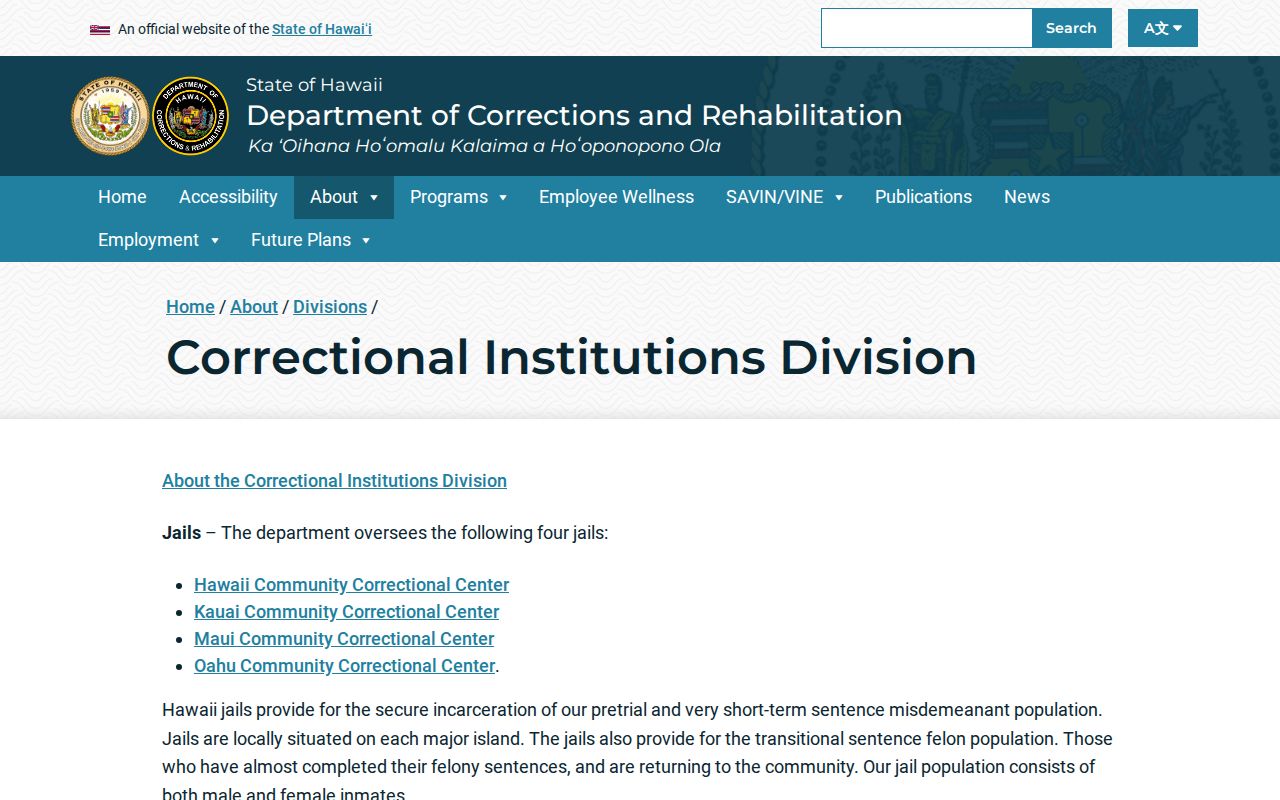
The list also shows why a custody trail may cross islands or pass through the contracted Saguaro Correctional Center in Arizona.
WCCC needs special care because a search limited to OCCC can miss a woman held on an Oʻahu matter. Laumaka is a work-furlough and pre-release operation, not proof of unconditional discharge. Maui Intake Service Center is an intake, records, pretrial, furlough, and transition office rather than a stand-alone long-term prison. Facility names should be matched to their actual function before drawing a release conclusion.
Federal Releases Connected to Hawaii
The Bureau of Prisons Inmate Locator is the nationwide search for a federal inmate or former federal inmate. It accepts several federal identifier types as well as name and biographical fields. BOP says its locator covers federal inmates incarcerated from 1982 to the present. Older records may require the National Archives. A former inmate's result may show “Released” or “Not in BOP Custody,” a date, and no current institution.
The BOP Inmate Locator is the official release-status starting point for federal custody.
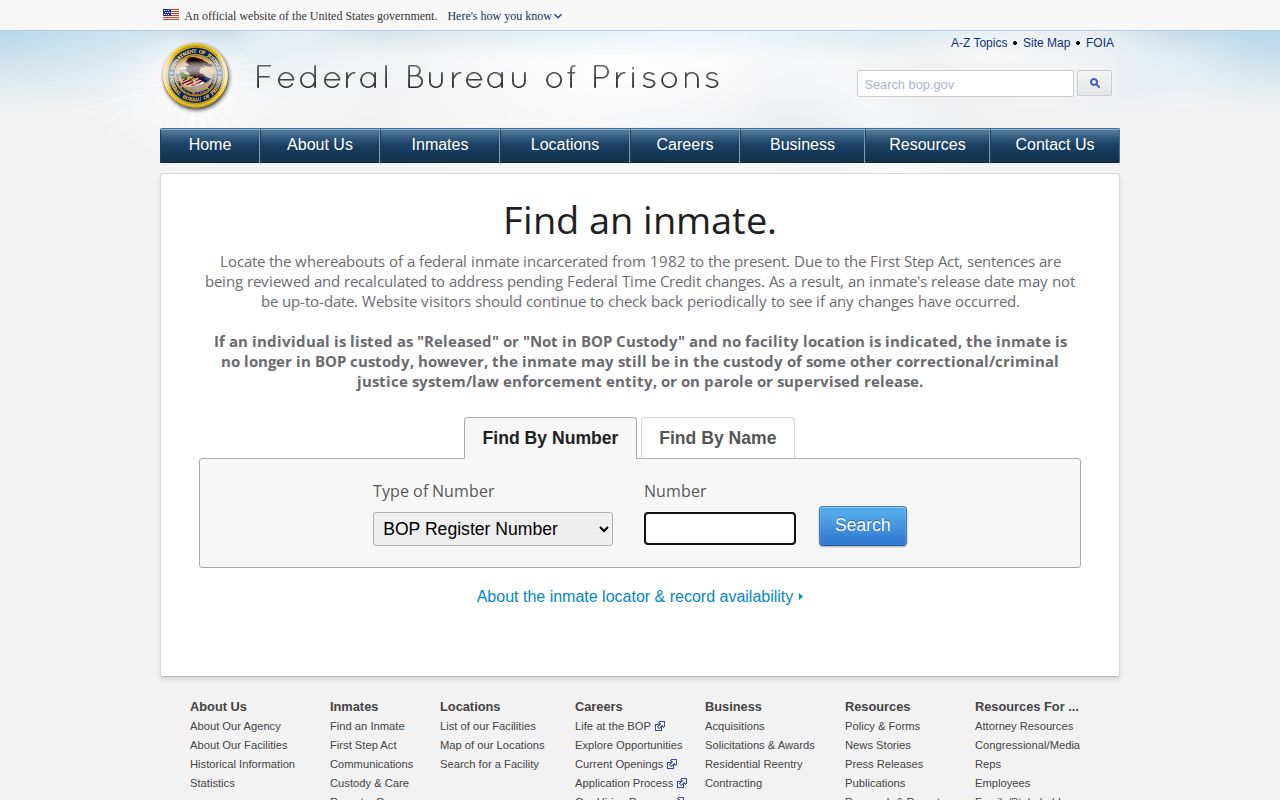
A BOP release result proves only the end of the BOP custody shown and does not rule out federal supervision, USMS control, DCR custody, or an ICE transfer.
FDC Honolulu is Hawaii's named federal detention center, but a federal defendant from any island may be held or designated elsewhere. ICE uses its Online Detainee Locator System for immigration custody. A nine-digit A-number and country of birth can be used, with leading zeroes added to a short number, or the search can use exact name and birth details. ICE does not display people under eighteen and describes limited post-release coverage that should be checked against the live interface.
A DCR transfer to ICE, USMS, or BOP is not community release. Continue the trace in the receiving system and preserve the sending agency's disposition. The federal court docket may explain the legal basis while the relevant locator shows only that agency's current or former custody slice.
Prove Hawaii Supervision Discharge
Release from a correctional site and discharge from supervision are separate endpoints. Parole follows a state prison release and is administered by the Hawaiʻi Paroling Authority. Probation is imposed by a court and managed through the Judiciary's adult probation or client-services structure. A person can also be on pretrial supervision, in a furlough placement, or fully off supervision. Those labels should not be merged.
For parole, begin with a matching SAVIN status, then seek the HPA action and any final discharge record. HRS section 353-70 permits HPA to give a parolee a written discharge from further liability under the sentence when the statutory findings are met. It also provides administrative consideration after at least five years on parole and annual reconsideration when discharge is not granted. That written discharge with an effective date is stronger proof than a missing VINELink result.
Probation ends under the sentencing court's authority. The docket may show a discharge, satisfaction, revocation, or later order, while internal supervision notes may be confidential. A certified court order is the sound choice when formal proof is needed. An alleged warrant or “whereabouts unknown” label should also be checked through the responsible court or law-enforcement channel rather than reported as current location.
What proves that release occurred? Use the executed DCR or police record for physical departure, the court or HPA record for legal authority, and the receiving agency record when custody continued elsewhere.
Note: An HPA discharge record closes the parole trail; an old parole label or silent search result does not establish that endpoint.