
DCR Hawaii Release Authority
The DCR home page confirms the agency name and provides the statewide starting point for correctional information. DCR replaced the former Department of Public Safety as Hawaii's correctional agency on January 1, 2024. Its Correctional Institutions Division operates both prisons and four community correctional centers. That structure matters. HCCC, KCCC, MCCC, and OCCC perform jail functions, yet they are state facilities rather than sheriff-run county jails.
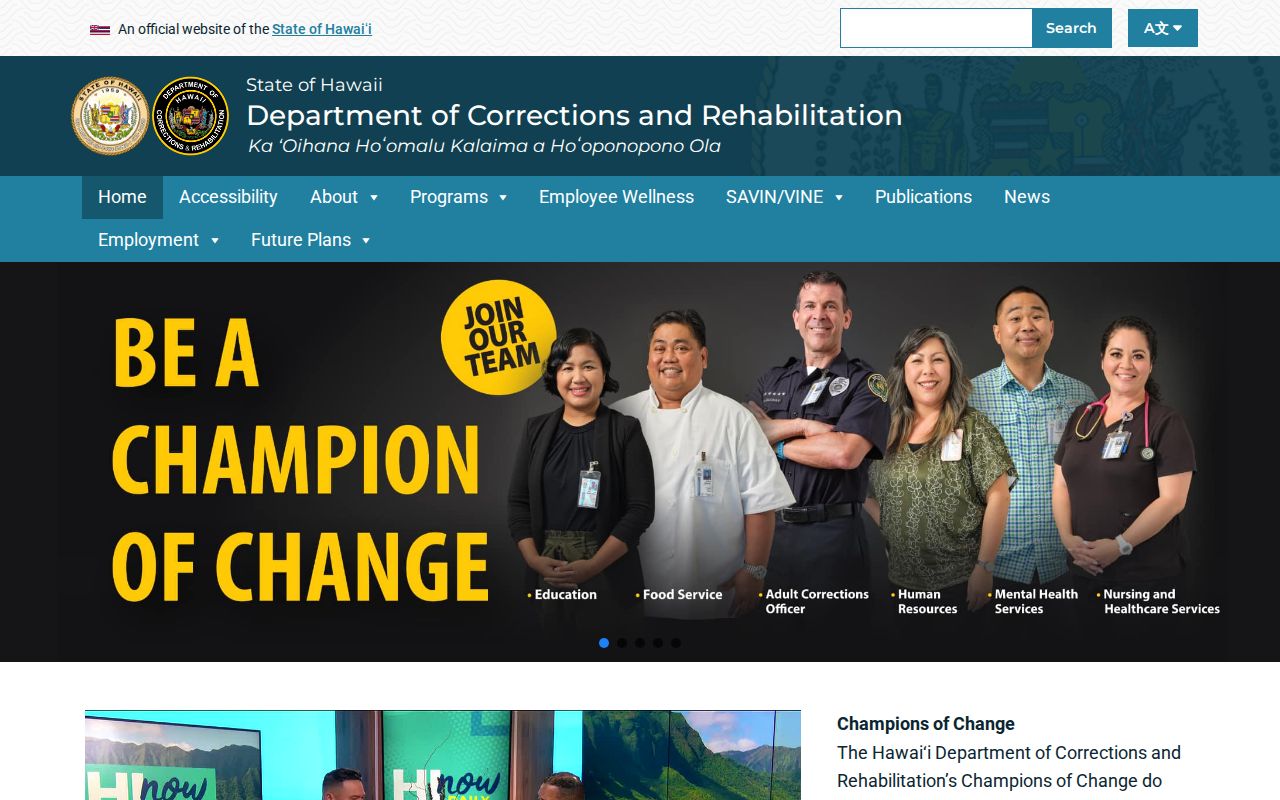
The captured page shows the official agency identity and its Locate an Offender route. It should be used as a doorway, not as proof of one person's release.
DCR records arise from several parts of one custody chain. A community correctional center may hold a pretrial person, someone serving a short term, a parole violator, or a prisoner in transition. A prison such as Hālawa, Kulani, Waiawa, WCCC, or contracted Saguaro holds sentenced prisoners. The same DCR name can therefore sit on very different records. First identify the custody type, then ask whether the event was bail, court release, transfer, furlough, parole, maximum-term expiration, or final discharge.
Use the DCR Offender Search
Hawaii does not publish a separate DCR historical offender-profile database. The official DCR offender search route is Hawaiʻi SAVIN, which sends users to the Hawaii VINELink person search for custody and parole information. Coverage is limited to offenders under DCR jurisdiction. The public description does not promise that every former offender stays visible for a fixed time, so the search is best for a current or recent status check.
The direct Hawaii person search shows the live interface used for that check.
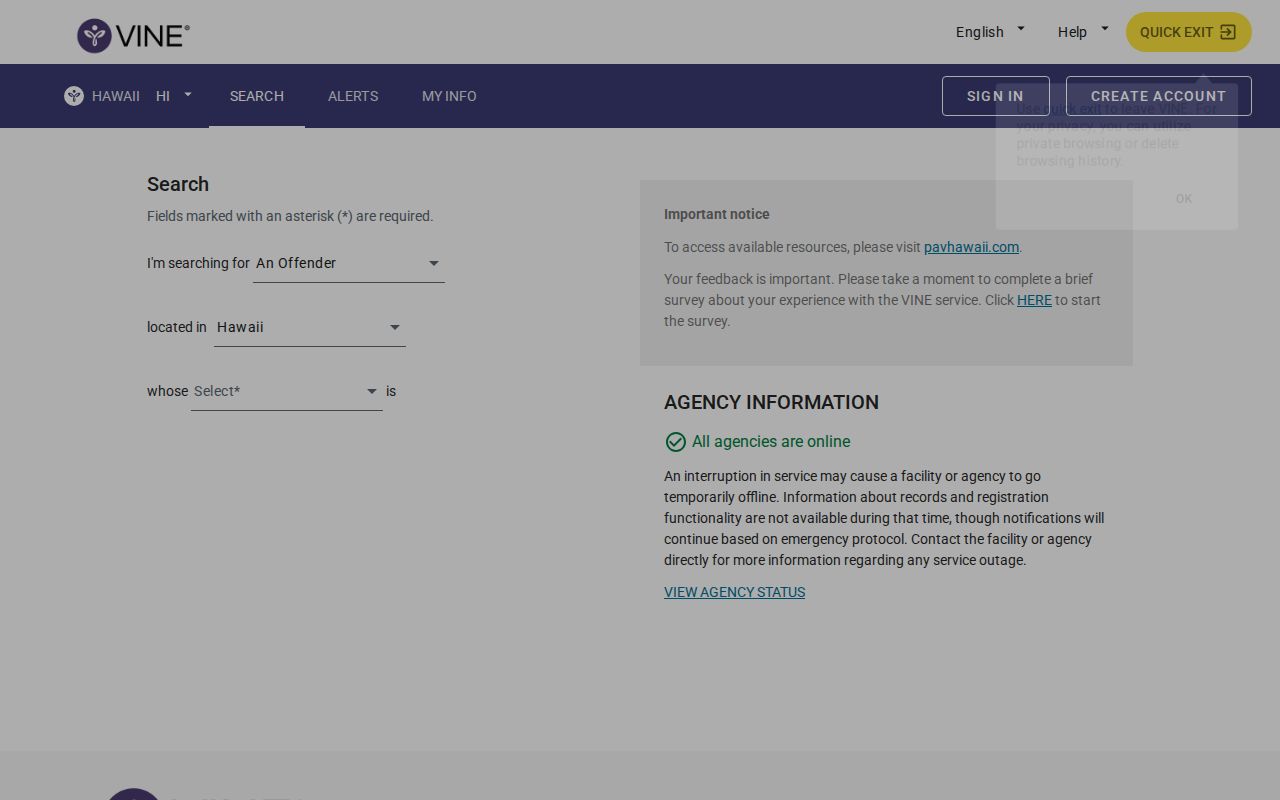
The screen is a search point, not a complete historical index. Keep the literal result wording and the time checked when the difference between parole, release, and transfer matters.
- Read DCR's SAVIN scope and warning, then open the direct Hawaii person search.
- Enter the name or identifier fields offered by the live form. Preserve hyphens, spaces, ʻokina, aliases, and multiple surnames.
- Open only a result that can be matched with known details. Similar names are not enough.
- Record the exact custody or parole label, agency or facility, event date shown, and check time.
- Compare a release event with the court case and HPA record. If no result appears, use the records-request route rather than declaring discharge.
VINELink can support email, text, telephone, and in-app notices. DCR also warns that the service does not warrant complete or fully current information. A dynamic status should therefore be checked against the office that created the underlying record when a precise departure time, release basis, or receiving authority is needed.
DCR Released Record Limits
A matching public record may display or notify a custody release, out-of-custody event, parole event, transfer, escape, or death. The exact label is crucial. DCR sources do not verify a standard Discharged badge, a fixed release-type field, a photograph, or an exact release timestamp on every public result. They also do not state how long a released person remains searchable.
| Public item | How to read it |
|---|---|
| Name or identifier | Use it to distinguish the intended person, but confirm with another known record. |
| Custody or parole status | Quote the live label. Do not replace parole, transfer, and discharge with one broad term. |
| Agency or facility | It identifies the reporting custody source, not always the final place in the custody chain. |
| Event date | Record what the interface actually calls the date. It may not be an executed release timestamp. |
| No matching result | It can reflect spelling, age, scope, transfer, police-only custody, federal custody, or a data issue. |
For an older event, use DCR's maintained record and eCourt Kōkua. The court docket can establish a dismissal, bail order, sentence, or later court action. DCR's executed movement record establishes what staff processed. Neither source should be made to answer the other's part of the event.
Note: Public retention for released VINELink records was not verified, so absence from a search is not evidence of final discharge.
DCR Release Record Fields
The operational release file can be much richer than the public search. DCR policy COR.16.02 requires an identity check, review of the legal authority, checks for charges and holds, release documents, return of property and money, and an Offendertrak update. DCR 8219 is the named Release Checklist. DCR 8281 is a Release Status Form. The releasable fields vary with the event and with UIPA limits.
| Requested field | What it can establish |
|---|---|
| Full name and DCR number | The identity tied to the correctional episode. |
| Admitting and releasing facility | The start and end points within DCR's custody trail. |
| Departure date and time | The actual processed movement, when releasable. |
| Disposition code and definition | Whether the event was community release, parole, transfer, court discharge, or another category. |
| Supporting authority | The type of court, parole, or other legal document staff acted on. |
| Receiving authority or destination | Whether another custodian received the person instead of release to the community. |
| Final Offendertrak entry | The status entered when DCR completed the event. |
Personal identifiers, victim data, medical facts, sponsor details, security information, and some hold information may be redacted. Ask for reasonably segregable public portions. That phrasing lets DCR remove protected matter while still considering the rest of the release record.
DCR Hawaii Release Types
A pretrial jail episode can end through bail, own-recognizance release, supervised release, dismissal, time served, probation, or transfer. A sentenced prison episode more often ends through parole, a furlough or pre-release move, maximum-term expiration, court action, or transfer. Work furlough and extended furlough may place a person in the community while DCR still has legal authority. Those placements are not final discharge.
- Parole
- Conditional community release during a sentence, granted through the Hawaiʻi Paroling Authority after the lawful minimum.
- Furlough
- A temporary or pre-release placement that can permit community access while legal custody continues.
- Transfer
- A move to another facility or authority, not proof that all custody ended.
- Final discharge
- The endpoint of parole authority under the governing sentence, supported best by an HPA order or certificate.
HRS sections 353-68 and 706-670 govern core parole steps. A parole grant is still distinct from physical release. A plan can require approval, a detainer can remain, and processing must be completed. The sound record trail joins the HPA outcome to DCR's actual departure record.
Hawaii Courtroom Release Location
DCR's statewide procedure has an unusual release-location rule. After acquittal, dismissal, or nolle prosequi, a person with no other hold is released at court rather than sent back to the correctional facility. Personal property may be collected later. A family member who waits at a jail gate can therefore miss the true point of departure.
This rule also explains why the court record and correctional record must be read together. The court supplies the authority. DCR checks identity, other charges, and holds, then executes the action required by the order. If another valid hold exists, release from the court case does not end custody. Ask the DCR record for the destination category and hold resolution when those fields can be disclosed.
Release policy requires staff to return personal property and money as soon as practical. No statewide source reviewed here guarantees a set cash payment, a bus ticket for each person, a fixed release hour, or a standard weekend process. Program aid must be confirmed with the responsible facility.
DCR Releases Across Hawaii
The DCR correctional institutions page identifies the statewide facility system and links current population reports.
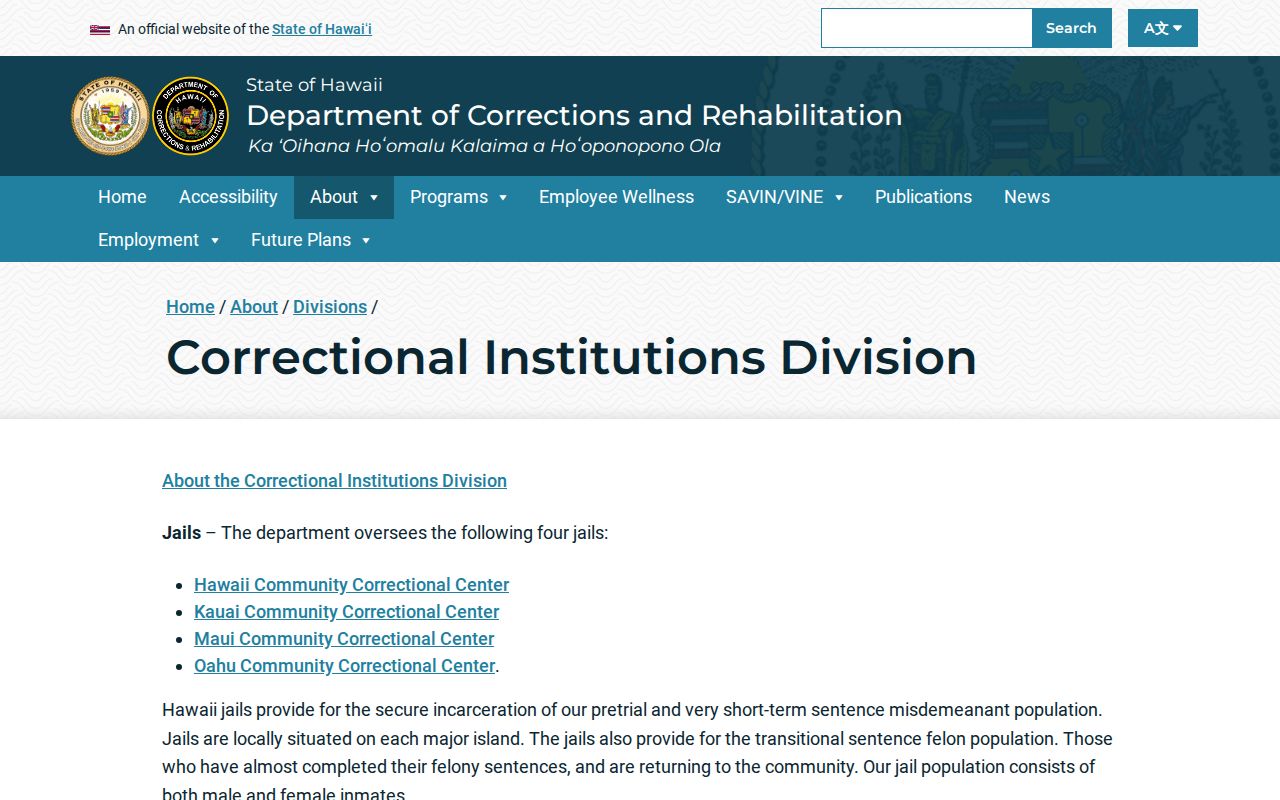
The image helps show why a statewide inquiry cannot stop with one island. The case county, confinement site, release county, and supervision office may all differ.
Hawaii's prison layer includes Hālawa, Kulani, Waiawa, and WCCC. Some Hawaii prisoners are held at Saguaro Correctional Center in Arizona under contract. The community correctional centers are HCCC, KCCC, MCCC, and OCCC. WCCC also performs an Oʻahu jail function for women. Laumaka is a furlough or pre-release operation, while MISC is an intake, records, and transition office rather than a separate long-term prison.
A move from Saguaro to an island institution near a possible parole date is a transfer, not a completed release. Likewise, movement to Laumaka does not prove unconditional discharge. The statewide Facility Directory routes to the local page for each documented institution or holding operation and helps identify which office may hold the record.
Police custody adds a separate first layer. Police cellblocks in Hawaiʻi, Honolulu, Kauai, and Maui counties can hold a person for short-term arrest processing before court, release, or DCR transfer. Their logs answer the police episode. They do not prove a later DCR prison discharge. This distinction is vital when a name never appears in SAVIN because the person left a police cellblock without entering DCR jurisdiction.
WCCC also needs a careful search because it serves as the women's prison and performs an Oʻahu jail role for women. Looking only at OCCC may miss the relevant DCR custody path. At the federal layer, FDC Honolulu belongs to the Bureau of Prisons, not DCR. Immigration custody uses ICE records. The responsible sovereign must be identified before a missing DCR result can be interpreted.
DCR Parole Release Measures
DCR publishes weekly and month-end population reports rather than a live count of statewide releases. Population, admission, transfer, and release are different measures. Each figure needs its own report date. HPA annual reports provide a clearer decision series, but a hearing result still is not an executed release.
The DCR annual report index is the source captured for dated departmental reporting.
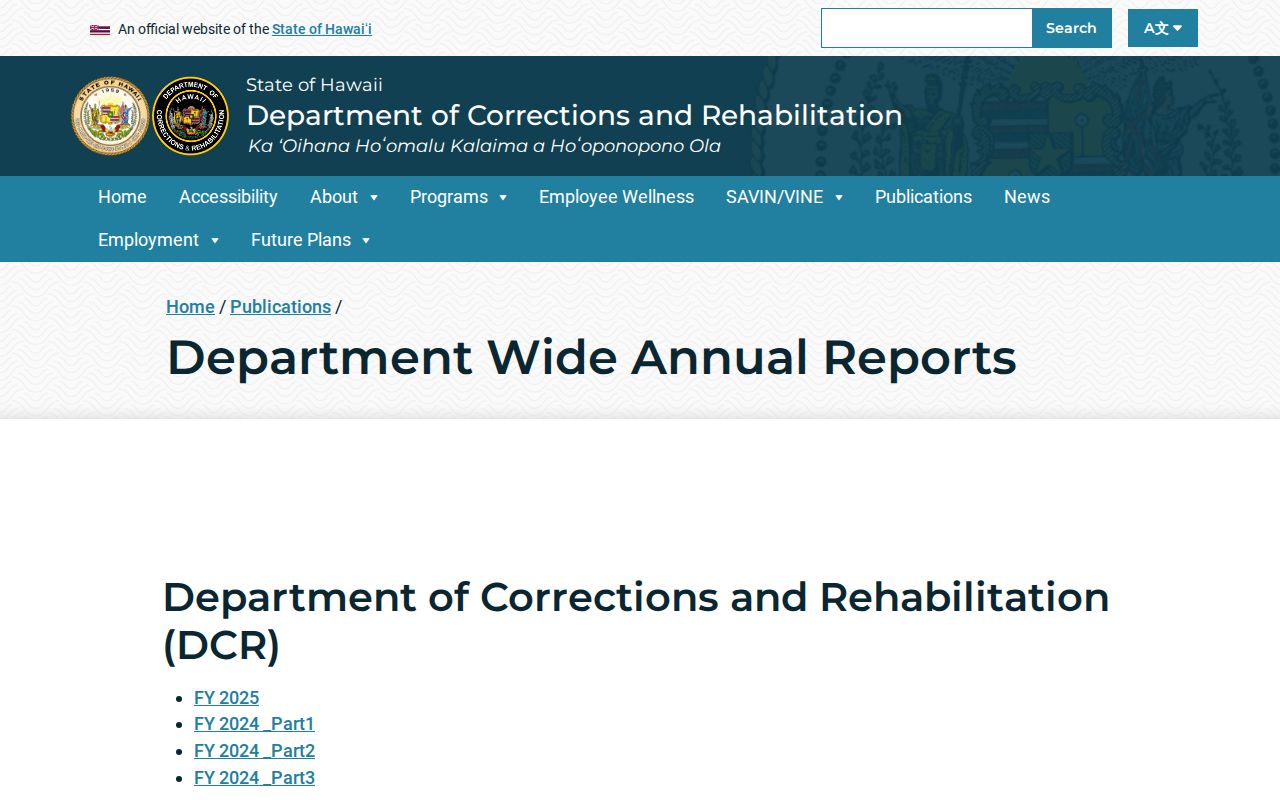
The index is useful for selecting a fiscal-year source. Figures from different years should not be blended into a single current total.
| Fiscal year | Consideration hearings | Parole grants |
|---|---|---|
| FY2021 | 2,431 | 900 |
| FY2022 | 1,861 | 528 |
| FY2023 | 1,685 | 447 |
The FY2023 report also lists 1,058 denials and 180 deferrals or continuances. The three-year series shows fewer hearings and grants, but it does not establish a cause. One person can have more than one hearing, and a grant may come before later release processing.
Separately, the state's dated FY2023-24 actuals list 439 paroles granted, 895 denied, and 189 revoked. They also report 36 parolees reviewed for discharge and an average six years on parole before final discharge. These are measures of decisions and supervision work, not a count of unique people leaving prison.
The same FY2023-24 report lists 997 parolees under Hawaii jurisdiction, 1,175 minimum sentences fixed, and 1,537 people considered at minimum expiration. It reports that 38 percent were granted parole at minimum expiration. The parole supervision table separately records 997 Hawaii-jurisdiction parolees supervised in state, 122 supervised out of state, and 50 people from other jurisdictions supervised in Hawaii. These overlapping measures describe workload and legal status. They must not be added to create a release total.
The report also lists 224 discharge recommendations, 223 arrest warrants, 141 interstate compact agreements, 180 people under specialized supervision, and 54 under intensive supervision. Dated detail can help locate the right HPA record type. It cannot answer whether one named person left a facility on a certain day. That question still turns on the individual HPA action and DCR movement record.
Note: A parole grant and an actual DCR departure are separate events, so both records are needed to confirm release.
Request DCR Release Records
Hawaii's Uniform Information Practices Act, HRS chapter 92F, supplies the public-record path. Send the OIP Request to Access a Government Record form to DCR as the agency that maintains the correctional record. Identify the person, DCR number if known, facility, and approximate dates. Ask for existing records rather than asking staff to decide whether someone was released.
The Office of Information Practices forms page provides the request and agency-response forms.

The form is the clean route for requesting DCR 8219, the actual movement time, disposition, supporting authority, final Offendertrak entry, and a sentence computation.
- Name the person, known DCR number, facility, and a narrow date range.
- List the exact existing items sought, such as DCR 8219, DCR 8281, departure time, disposition code, or sentence computation.
- Ask for electronic delivery, a fee estimate, and reasonably segregable nonexempt portions.
- Keep the agency response and any stated exemption. OIP guidance generally calls for a response within ten business days, though production may take longer under extended procedures.
Lawful search, review, segregation, copying, and delivery fees can apply. There is no flat price that should be assumed. The current DCR UIPA routing contact should be checked on DCR's frequently called numbers page before sending the request.
A focused request can name the Release Checklist, actual release or transfer date and time, disposition and code definition, supporting legal-document type, releasing facility, receiving authority, final Offendertrak status, and any computation that states the tentative date of release. This list asks DCR to locate records it already maintains. It does not require staff to research a narrative or make a new judgment about the person.
HRS section 92F-13 permits withholding for specified grounds, including some personal privacy and government-function concerns. If DCR denies or redacts material, retain the written reason and compare it with the exact requested field. A narrow follow-up may succeed where an all-or-nothing file request does not. For parole's end, seek the HPA discharge order or certificate as well. A missing public profile is much weaker proof than an agency record with an effective date.