
What Hawaii VINE Covers
Hawaiʻi SAVIN is the Statewide Automated Victim Information and Notification service. The Hawaiʻi Department of Corrections and Rehabilitation, commonly called DCR, describes it as a free source of custody and parole information for offenders under DCR jurisdiction. Registration is anonymous and confidential, and DCR says the person in the record is not told who registered. Access is available through the web, a mobile app, telephone, and TTY. The service therefore supports both a one-time Hawaii VINE inmate check and ongoing notice about a matched person.
This scope is unusually important in Hawaii. DCR operates the four community correctional centers that perform the jail function, as well as the state prisons. A search can follow a DCR custody trail across HCCC, KCCC, MCCC, OCCC, the in-state prisons, and a contract placement such as Saguaro. Police cellblocks remain a separate short-term layer. A person who leaves police custody before entering DCR may not be covered by the statewide DCR feed.
The DCR home page identifies the department and provides its official “Locate an Offender” route.
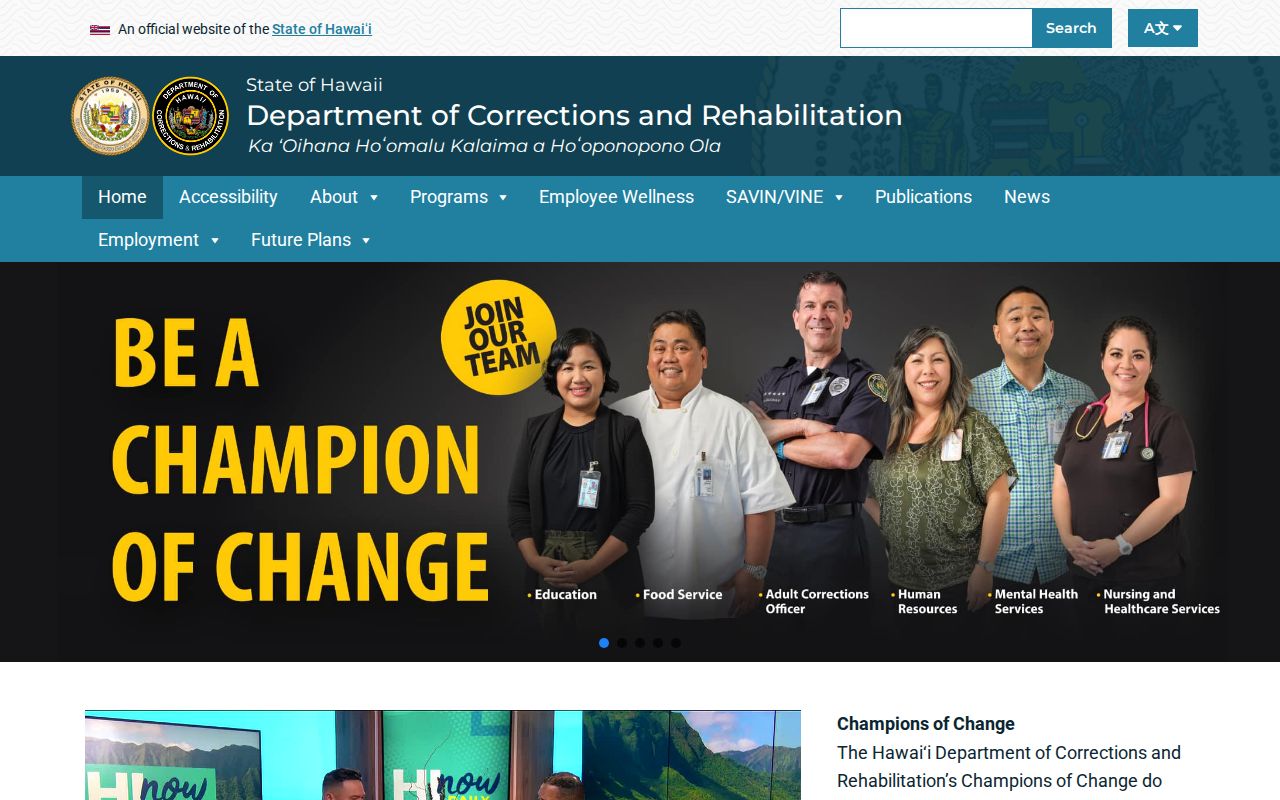
The captured page helps confirm that the locator belongs in a DCR release workflow, even though the actual person search runs through VINELink.
Search Hawaii VINE for One Person
Start with known facts, not a broad guess. Exact spelling matters, especially for names with spaces, hyphens, multiple surnames, or an ʻokina. A neutral identifier from a court or custody record can help separate people who share a name. The live interface controls which name and identifier fields are available, so follow what it asks rather than assuming every record includes the same data.
- Open DCR’s SAVIN information page or go to the direct Hawaii person search.
- Select Hawaiʻi and enter the person’s name or an accepted identifier exactly as known.
- Compare all returned matches before opening a record. Check the agency, facility, and identifiers shown.
- Open the best match and copy the literal custody or parole status, event date, and agency name.
- Record when the search was made, since a live result can change after a transfer or release event.
If no match appears, vary only details that may truly differ, such as a former surname or spacing. Do not treat absence as proof of release. The person may be in police-only holding, another state, federal custody, immigration custody, a confidential system, or an older record that is no longer returned. For island-specific police and facility routes, use the Hawaii County Directory to reach the right local guide.
The direct Hawaiʻi VINELink person search is the public interface DCR points users toward.
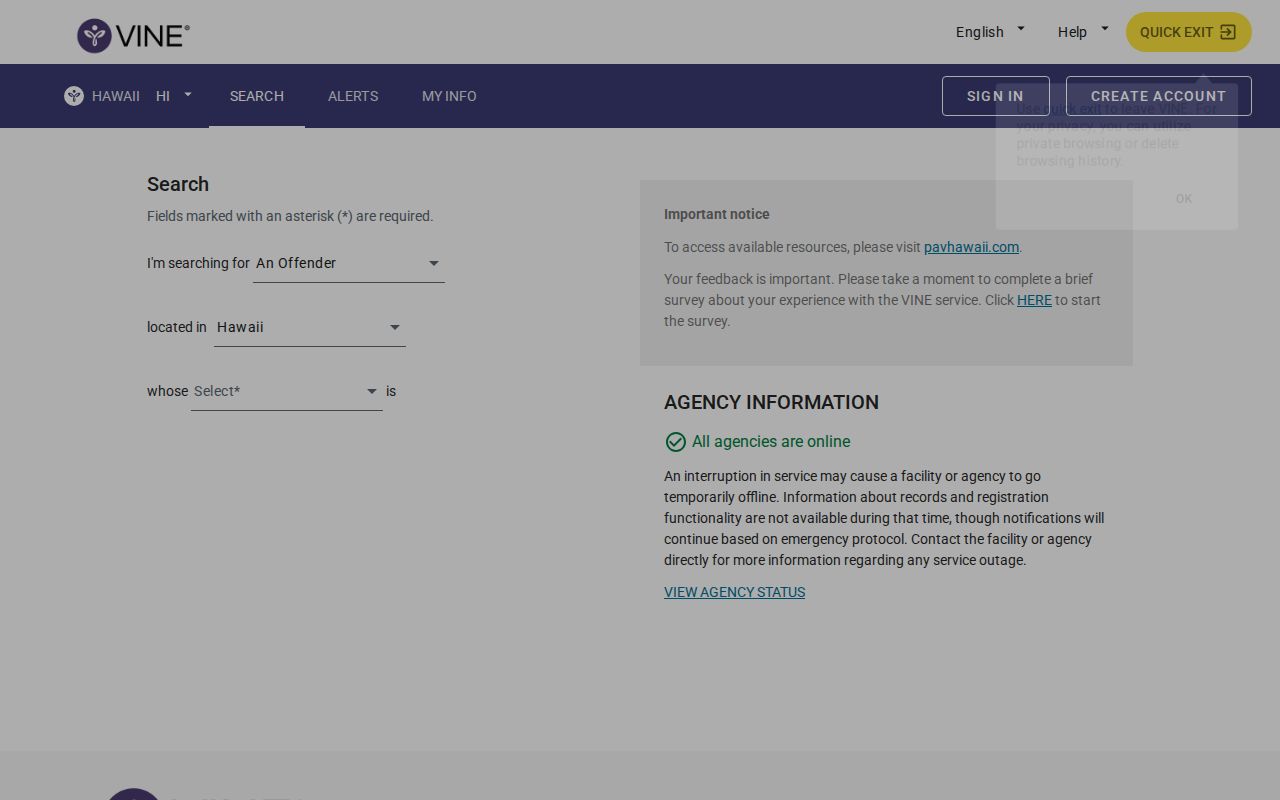
This screen is the starting point for a named-person check, not a statewide list of everyone recently released.
Read a Hawaii VINE Release Result
Copy the words shown on the matched record. Do not convert “transfer,” “parole,” “out of custody,” “release,” or “discharge” into a different event. A release can mean the end of the DCR custody episode shown, while parole can mean physical release with supervision still in force. A transfer means custody continues under another facility or agency. Final discharge is a later endpoint that may require a Hawaiʻi Paroling Authority record.
Fields vary by the person and the live system. The table describes the points to inspect without promising that each one will appear on every profile.
| Field | What it can establish |
|---|---|
| Name and identifier | Whether the result likely belongs to the intended person. |
| Custody or parole status | The exact state reported by the contributing DCR source. |
| Agency or facility | Which part of the Hawaii custody system supplied the record. |
| Event and event date | A reported change such as release, transfer, escape, death, or a parole event. |
| Notification options | Which alerts can be requested for that matched record. |
No official DCR source promises a public projected or tentative release-date field on every VINELink profile. DCR uses “tentative date of release” in internal sentence computation and planning, but that phrase differs from an HPA minimum term, a tentative parole date, a maximum expiration date, and an actual release time. If a future date appears, label it exactly and do not report it as a completed release.
Register for Hawaii Release Alerts
Registration begins after the correct person record is open. The Hawaiʻi SAVIN brochure identifies custody events such as release, transfer, escape, and death, along with parole-hearing and parole-status notifications. Available event choices can differ by record. Telephone, text, email, and in-app delivery may be offered. The live control names and confirmation sequence take precedence because interfaces change.
- Confirm the record belongs to the intended person before choosing any alert option.
- Select the available notification control and review the listed custody or parole events.
- Choose the offered delivery method, such as telephone, text, email, or an app notice.
- Enter the requested contact details and complete the PIN or confirmation step shown.
- Keep the confirmation information and test or update the contact channel when the service permits.
DCR also lists a toll-free Hawaiʻi SAVIN line at 1-877-846-3444 and TTY access at 1-866-847-1298. Those official channels matter when the web search does not return the expected record or when a person needs help with registration. DCR warns users not to rely on SAVIN alone, so an alert should prompt a check with the agency that holds the person or processed the event.
Hawaii VINE Is DCR's Locator
Many states maintain a stand-alone historical offender database. Hawaii does not publish that kind of separate DCR profile search. Instead, the official DCR locator sends the public to Hawaiʻi SAVIN/VINELink for custody and parole information. This is the central statewide distinction. VINE is not merely a later alert step added after another corrections search. It is the public person-search route itself.
The distinction also sets a limit. DCR does not promise that every person released years ago will stay searchable for a fixed period. A missing profile cannot prove discharge. When a match remains available, note its literal status and date. When it does not, an HPA record, a court docket, or a DCR release record may be the stronger source. The DCR offender search explanation covers that statewide record trail in greater depth.
The DCR Correctional Institutions Division page shows the statewide facilities that can contribute to that custody trail.
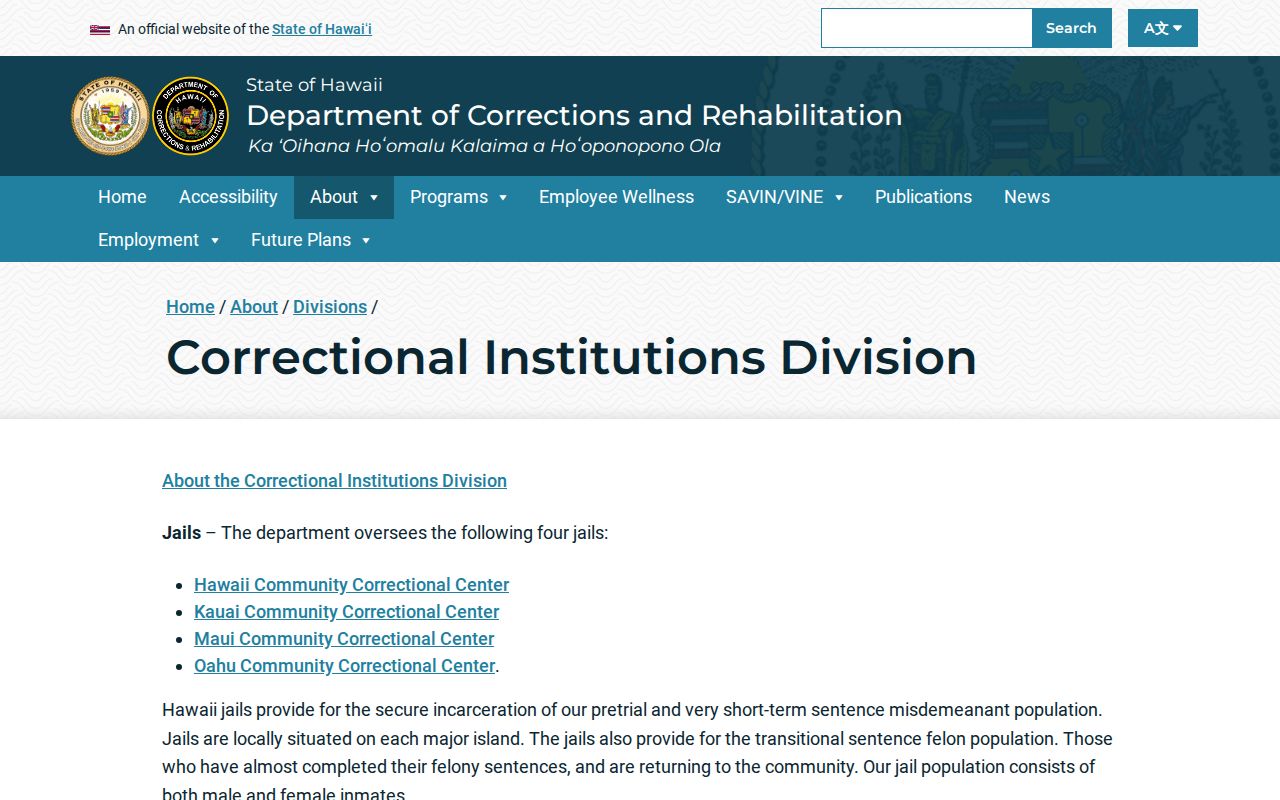
The facility list explains why one Hawaii VINE check may follow movement between an island jail function, a prison, and another DCR placement.
Confirm Hawaii Release Beyond VINE
VINE reports the custody or parole event supplied to it. A second source explains what that event means. eCourt Kōkua can preserve a bail order, dismissal, judgment, sentence, probation order, revocation, or later docket entry after a person leaves a live custody result. The court record shows legal authority, but it may precede the actual release process. Pair it with the DCR event or the releasing office’s executed record.
For parole, Hawaiʻi Paroling Authority records matter. Parole is supervised release, not final discharge. HPA materials distinguish early discharge, full-term discharge, revocation, continued parole, and actual release. A disappearance from VINELink does not replace a discharge order or certificate with an effective date. The same care applies to a court-ordered release that is delayed by another valid hold.
Search eCourt Kōkua by party name or case number, then verify identity from the docket instead of assuming that a matching name is enough. Older migrated Hawaii case numbers can require a circuit digit, case type, and leading zeroes to form the required twelve-character identifier. A PDF icon signals that a public document can be opened online. Sealed, confidential, and some older material may require a courthouse request or may remain unavailable. These court limits are different from VINE retention, so failure in one system should lead to the other source rather than a guess.
A records request can seek the release checklist, actual date and time, disposition, legal authority, receiving agency, final status entry, and a sentence computation already maintained by DCR. Ask for existing records and give the person’s name, known DCR or case number, facility, and date range. Request electronic copies, a fee estimate, and segregable nonexempt portions rather than asking staff to write a new narrative.
The Hawaii Office of Information Practices forms page provides the model request used under the Uniform Information Practices Act.
This fallback is useful when a VINE profile is missing, unclear, or too brief to establish the completed release event.
Hawaii VINE Limits by Custody Layer
Hawaiʻi SAVIN coverage is limited to offenders under DCR jurisdiction. It does not replace every other custody system. Police-only holding may end before DCR receives the person. Juvenile and confidential matters may not appear. Another state uses its own records. Federal and immigration custody each have a separate locator, and an apparent DCR release to another agency is a transfer of custody rather than release to the community.
A missing or delayed VINE result is not proof of release. Confirm the event with the agency, court, or facility responsible for it.
The BOP Inmate Locator accepts a federal number or name-based search and covers federal inmates from 1982 forward. A former federal inmate’s result may say “Released” or “Not in BOP Custody” and may show a release date. That proves only the end of the BOP custody displayed. Federal supervised release, USMS control, ICE detention, state custody, or another jurisdiction may follow.
The Federal Bureau of Prisons Inmate Locator is the correct comparison channel for a federal case.
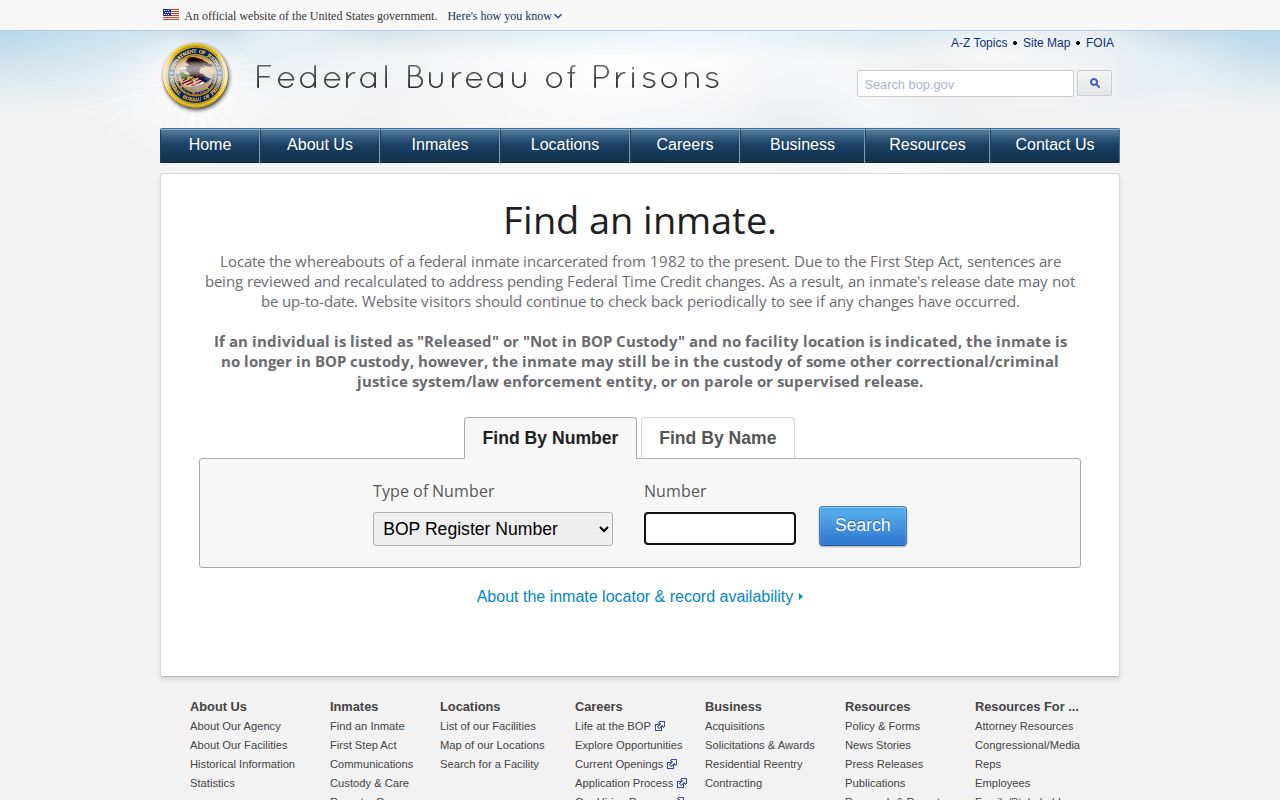
The federal screen shows why a DCR-focused Hawaii VINE search cannot answer every custody question in the state.
ICE’s Online Detainee Locator is separate as well. It uses a nine-digit A-number with country of birth or an exact biographical search. A DCR release to an ICE detainer is not community release. Continue the trace through ICE, and quote the live locator’s scope because the time for which a released person remains visible can change. For a no-result case, use the live operator or agency contact instead of drawing a conclusion from silence.
The biographical ICE search calls for exact first and last names plus country of birth, with birth date available as an added filter. Shorter A-numbers must be padded with leading zeroes for the number search. The locator excludes people under eighteen and covers certain people held by CBP for more than forty-eight hours. Those limits explain why one failed ICE query cannot settle the custody trail. The official Detention Reporting and Information Line is the documented fallback for a no-result search or basic case information.
What if VINE and the court disagree? Preserve both time-stamped results and ask the releasing office for the executed record. The court can authorize release while DCR still completes identity, hold, property, and status checks.
Note: Status feeds can lag, and the responsible agency remains the source for a final custody or release confirmation.