
Hawaii Paroling Authority
The Hawaiʻi Paroling Authority, or HPA, is the statewide board responsible for minimum terms, parole release decisions, revocation, reparole, and discharge matters. It stands between the court's sentence and some later release decisions, but it does not replace DCR's custody record. A court sets the sentence, HPA fixes or applies the parole framework, and DCR records the person's actual movement from custody.
HPA's official resources include its parole handbook, administrative rules, minimum-term guidelines, annual reports, pardon application, minimum-reduction forms, and transfer forms. The agency states that hearings for people in Hawaii correctional facilities are conducted in person. Out-of-state matters may proceed by video or telephone conference. That distinction is relevant because Hawaii prisoners may be housed outside the islands, including at the contracted Saguaro Correctional Center.
The Hawaii DCR home page establishes the agency setting in which the HPA and offender-location routes operate.
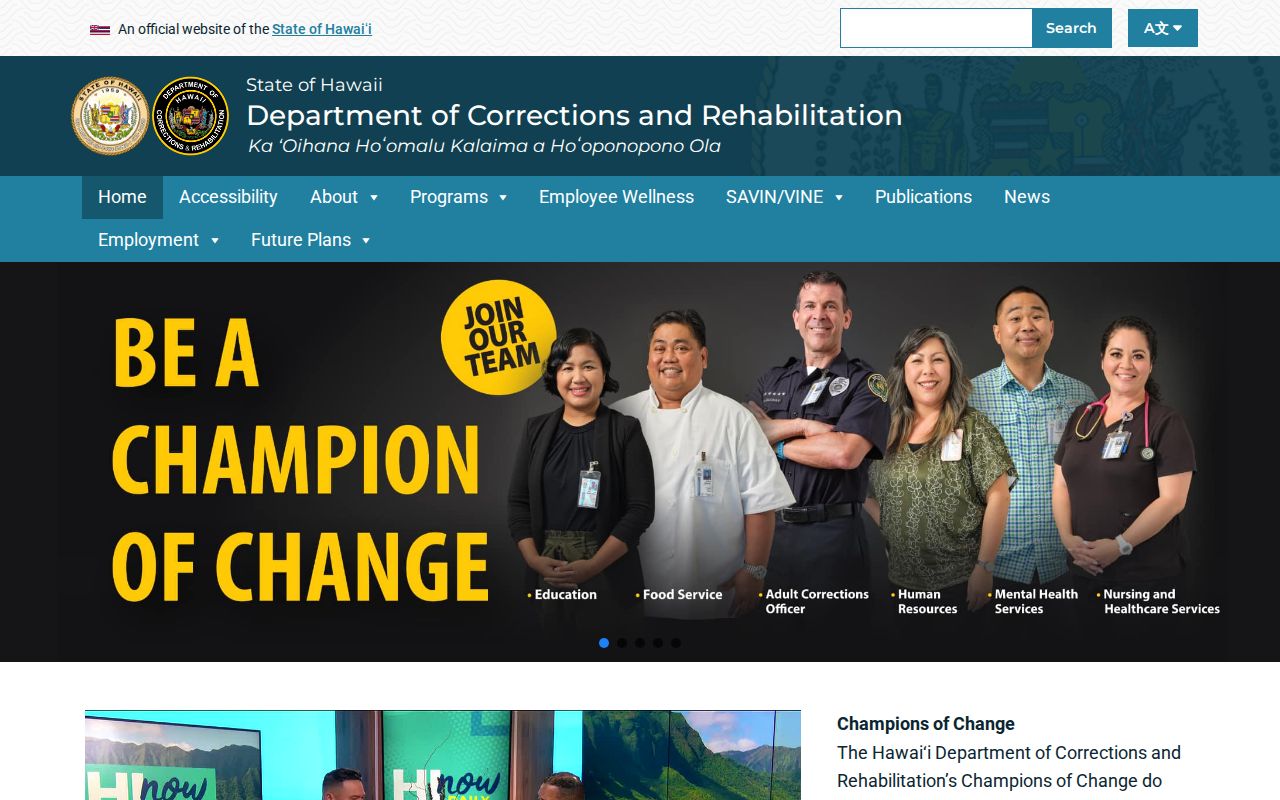
DCR's public navigation helps locate HPA resources, but it is not an inmate-specific hearing docket.
- Minimum hearing
- A proceeding that fixes the minimum imprisonment that must be served before parole eligibility.
- Parole hearing
- A proceeding that decides whether conditional release on parole should be granted.
- Revocation
- A proceeding about whether parole should be revoked after an alleged violation.
- Reparole
- A later decision on release to parole following recommitment.
- Discharge
- An action that ends parole authority or further liability under the controlling sentence.
Find Hawaii Parole Hearing Dates
No official dedicated person-level HPA hearing calendar was found in the statewide research. HPA links to the State of Hawaii's general calendar, but that calendar is not a substitute for a named prisoner's parole docket. There is also no verified monthly posting schedule to cite. A search should therefore begin with records that identify the person and the type of HPA proceeding.
- Gather the full name, DCR number if known, correctional facility, criminal case number, and the kind of proceeding expected. Do not assume every HPA event is a parole-release hearing.
- Review the individual HPA notice, minimum-term order, court record, or counsel's file for the stated date. These records provide stronger person-level detail than a general public calendar.
- Check Hawaiʻi SAVIN for the matching person and any supported parole-hearing notification. Record the exact event language and check date.
- Contact HPA through the current details on its official page. Ask for the releasable date and proceeding type, and provide enough identifiers to avoid a same-name match.
- Recheck shortly before the event. A continued, rescheduled, or administratively reviewed matter should be described by the later official notice.
The Hawaii VINELink person search supports DCR custody and parole information for matching people.
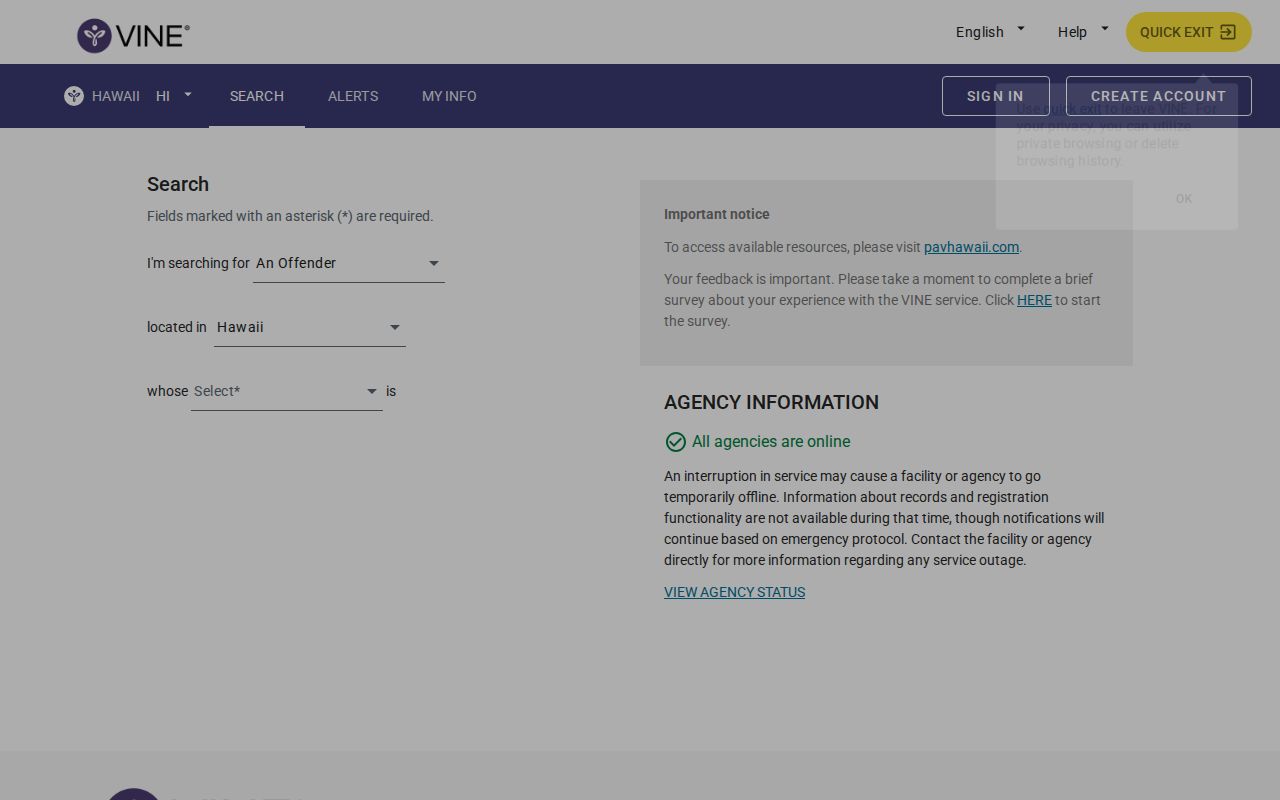
VINELink can support the search and notice process, but HPA remains the source for the hearing date and proceeding record.
Request Hawaii Parole Decisions
Hawaii does not offer a verified searchable HPA decisions database. State law still creates a clear public-result duty. HRS §353-62(b)(2) requires HPA, no later than thirty days after a parole-release hearing, to make public the prisoner's name and whether the request was approved or denied. That rule supports a focused request even when no web search returns the result.
- Identify the person, DCR number if available, facility, and approximate hearing date. State that the request concerns a parole-release hearing.
- Cite HRS §353-62(b)(2) and request the hearing date, the required approved-or-denied public result, and the releasable decision or order.
- Ask HPA to separate and provide nonexempt material if part of the file is withheld. A request for an existing record is clearer than asking staff to explain the case.
- Compare the result with DCR or SAVIN for any later custody event. Preserve each source date because a decision and actual departure may occur at different times.
Hawaii's Uniform Information Practices Act also provides a general request path for maintained government records. The Office of Information Practices forms page includes the Request to Access a Government Record.
A narrow request for the hearing date, result, and releasable order is easier to process than a broad demand for the full parole file.
Hawaii Parole Hearing Outcomes
HPA reports use several outcome categories. Each answers a different question. A grant concerns parole approval, while an actual release measure concerns physical departure. Deferral or continuance means a final decision was not made at that point. Revocation and discharge concern later stages of parole. The literal label and date should be retained.
| Outcome | Meaning | What to verify next |
|---|---|---|
| Granted | HPA approved parole, subject to the controlling terms and release process | Confirm the effective plan, holds, and DCR departure record |
| Denied | Parole release was not approved at that hearing | Read the order and later review information |
| Deferred or continued | The matter was postponed or left for later action | Obtain the new notice or next HPA date |
| Revoked | Parole was ended after the required process | Check recommitment and any later reparole record |
| Discharged | HPA ended parole authority or liability under the sentence | Obtain the written discharge and effective date |
HPA's FY2023 report illustrates why the distinction matters. It recorded 1,685 parole-consideration hearings, 447 grants, 1,058 denials, and 180 deferrals or continuances. Those are hearing measures, not a count of people who walked out of custody. One person can have more than one hearing, and a grant may precede actual release.
The DCR annual-report index provides dated operational context for Hawaii correctional and parole activity.
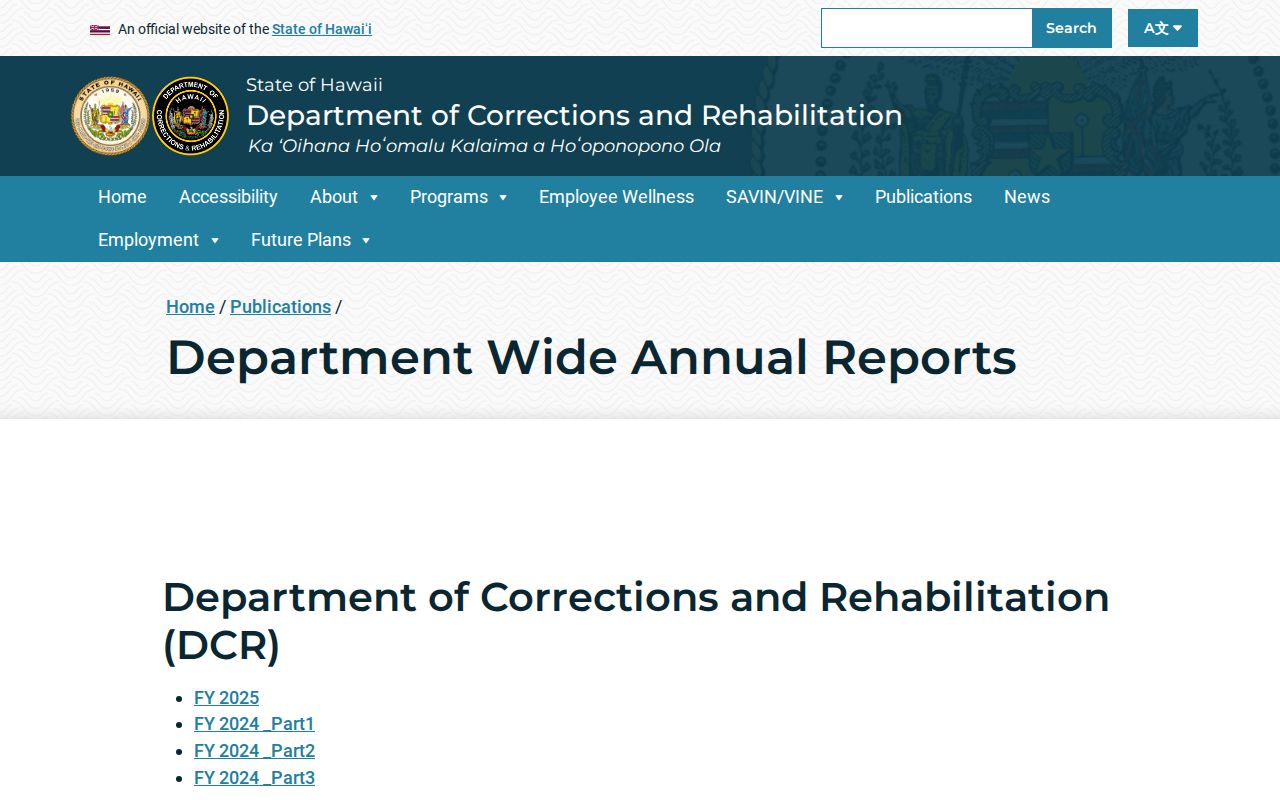
Aggregate reports help explain state trends, but a named person's result must come from the individual HPA record.
Hawaii Parole Hearing Trends
HPA's dated reports separate hearings from people considered and outcomes. In FY2023, the agency reported 1,685 parole-consideration hearings involving 1,277 people, along with 447 grants, 1,058 denials, and 180 deferrals or continuances. Since one person may appear in more than one proceeding, the hearing count should not be described as the number of individuals who sought or received release.
The same report series recorded 2,431 consideration hearings and 900 grants in FY2021, followed by 1,861 hearings and 528 grants in FY2022. Both measures fell across the three fiscal years through FY2023. That is a dated descriptive trend, not evidence of a single policy cause. It also is not a current parole hearing schedule. For a named person, return to the individual notice, HPA response, and result required by law.
A later state variance report lists FY2023-24 actuals under different program measures: 1,537 people considered at minimum expiration, 439 paroles granted, and 895 denied. It also reports a 38 percent grant rate at minimum expiration. Those labels and time periods must remain intact. They should not be blended with the FY2023 annual-report table to create a new total.
Hawaii Parole Eligibility Rules
Hawaii's eligibility framework begins with the sentence and minimum term. HRS §706-669 directs HPA to hold a minimum-term hearing as soon as practicable and no later than six months after commitment on an indeterminate or extended term. The person receives notice and may be heard. HPA then orders the minimum imprisonment that must be served before parole eligibility.
The minimum is a threshold, not a promised release date. HRS §353-68 permits parole after the lawful minimum has been served, while HRS §706-670 provides the hearing and release framework. The latter generally calls for the initial parole hearing at least one month before the controlling minimum expires. Multiple terms, mandatory terms, and life-without-parole sentences require case-specific review.
HPA may consider the governing standards, risk assessment, institutional history, and the record before it. A person can complete the minimum and remain confined after a denial. A grant can still precede release planning, a detainer check, or another event. The controlling order and later DCR record answer different parts of the timeline.
Hawaii Minimum-Term Hearing Records
A minimum hearing is not the same as a parole-release hearing. It fixes the minimum term for an indeterminate or extended sentence. The HPA handbook also describes administrative review, which may examine institutional adjustment before minimum expiration. Later parole proceedings decide whether release should be approved.
Section 706-669 requires a verbatim record of the minimum hearing and makes HPA's minimum-sentence guidelines public records. For a named case, ask for the minimum-term order, the date it was issued, the controlling minimum, and any later modification or minimum-reduction order. Some parts of an individual file may be withheld under other law, so request reasonably segregable public portions.
The sequence can be written as: court sentence → HPA minimum-term hearing → minimum-term order → parole consideration → HPA result → DCR release processing → parole supervision. Not every case follows each step in the same way. The documents show which steps occurred.
Note: A hearing date, minimum-term order, parole grant, and actual DCR departure are separate records and may carry separate dates.
Hawaii Clemency and Parole
HPA's official page places a revised pardon application beside parole rules, reports, and minimum-term forms. That shared location can cause confusion, but a pardon and parole are different actions. A pardon is executive clemency. It is not an HPA parole discharge and does not, by itself, prove the timestamp when DCR released someone from custody.
Use the current application and instructions from the official HPA forms and reports page when the question concerns clemency. Use an HPA parole decision for the parole outcome, a written discharge for the supervision endpoint, and a DCR or court record for the custody event. One document should not be made to prove all three.
A clemency filing is also not a decision. Confirm whether the application was merely submitted, acted on, or granted, and preserve the exact document date. If custody release is the question, continue the trace through DCR, HPA, and the court rather than assuming that a form on the parole page changed custody.
Verify Hawaii Parole Release
A parole grant is not proof of physical release. DCR release staff must verify identity and legal authority, check charges, holds, and detainers, complete the required forms, account for property and money, and update the correctional record. An approved plan, transfer, detainer, or later order can affect the effective date. The final custody trail should show whether the person left the facility and whether another authority received them.
Hawaiʻi SAVIN may display or notify a parole or release event for a person under DCR jurisdiction. Quote the live status instead of promising a fixed field. If there is no result, try verified spelling and identifiers, then contact HPA or the responsible facility. A missing result is not proof of release, denial, or discharge.
For supervision after a grant, the Post-Release Supervision page distinguishes parole from court probation and explains how to seek the ending record. That later status must remain separate from the hearing outcome. A person can be released on parole, transferred to another custodian, still awaiting physical release, or fully discharged at different points in the same case.
DCR's release procedure also requires staff to update Offendertrak and accounts for a SAVIN notification contingency when that system is unavailable. The policy supports a later custody trace, but it does not promise a public update within a set number of minutes. When timing matters, request the actual departure date and time from DCR instead of estimating it from the hearing result.