
Hawaii Parole and Probation
Parole and probation are not two names for the same status. Hawaii parole is conditional release during an indeterminate prison sentence. The Hawaiʻi Paroling Authority, usually called HPA, grants and administers that release after the lawful minimum term has been served. Probation is imposed by a court as a sentence or disposition. It may begin without a prison term, or it may follow a shorter custody episode. The Hawaiʻi State Judiciary's adult probation and client-services structure administers probation through the circuit tied to the criminal case.
A person outside a jail may instead be on pretrial supervision, furlough, or no supervision at all. Furlough can allow movement in the community while DCR still retains correctional authority. Pretrial release occurs before final disposition. Neither should be labeled parole or probation without the record that creates that status. The Hawaiʻi Paroling Authority and the sentencing docket are the best starting points for keeping these categories distinct.
| Feature | Parole | Probation |
|---|---|---|
| How it begins | HPA grants conditional release during a prison sentence | A court imposes it as a sentence or disposition |
| Primary record owner | HPA and DCR | The sentencing court and its adult probation office |
| Public verification path | Hawaiʻi SAVIN, then HPA records | eCourt Kōkua, then the proper Judiciary circuit |
| Document showing the end | HPA discharge order or written discharge | Court discharge, satisfaction, or other final order |
The DCR home page identifies the statewide correctional agency and routes users to its public services.
That agency route matters for parole and DCR custody, but a probation record still belongs to the Judiciary.
Verify Hawaii Post-Release Supervision
No verified public statewide probationer database exists in Hawaii. There is also no verified public statewide list of parole absconders. A careful check therefore uses different official channels based on the type of supervision. Start with the criminal case and known custody facts instead of treating one missing search result as proof that supervision ended.
- Confirm the person's full name, case number, DCR number if known, and the island or circuit connected to the case. Preserve spelling, including spaces, hyphens, multiple surnames, and the ʻokina.
- For possible parole, search the matching person in Hawaiʻi SAVIN and record the literal custody or parole label, agency, event date, and time checked. Do not convert a transfer or out-of-custody label into a final discharge.
- Ask HPA for the current public or releasable status, the correct supervising branch route, and any discharge record. Give enough identifiers to distinguish people with similar names.
- For possible probation, search the sentencing case in eCourt Kōkua. Review the judgment, probation order, modifications, alleged violations, revocation entries, and discharge or satisfaction entries.
- Use the proper Judiciary circuit's adult probation or client-services contact when the docket is unclear. A certified court order is the stronger source when formal proof of completion is needed.
The direct Hawaii VINELink person search is DCR's public route for custody and parole information.
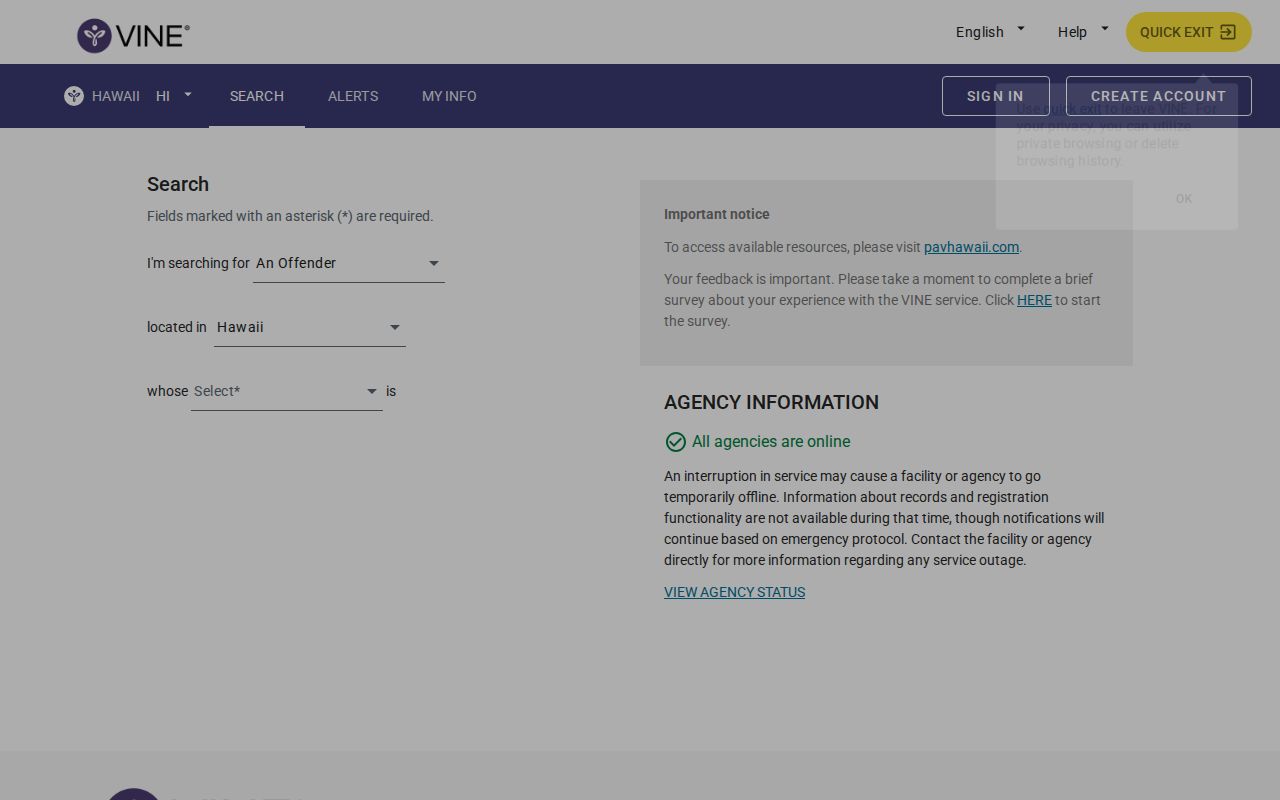
A match can guide the inquiry, but the live label should be checked against HPA or court records before stating the exact status.
Hawaii operates community correctional centers and prisons through DCR, yet the place of confinement and the later supervision office may differ. A case can begin on one island, involve confinement elsewhere, and route supervision through another branch. The County Directory helps identify the locality trail when the sentencing circuit is not clear.
Hawaii Supervision Agency Roles
HPA is the statewide authority for parole. Its official page provides the parole handbook, administrative rules, minimum-term guidelines, annual reports, and forms. HPA also handles proceedings tied to revocation, reparole, and discharge. DCR operates the correctional institutions and Hawaiʻi SAVIN. The Judiciary, not HPA, administers adult probation through the court system.
Hawaiʻi Paroling Authority
Statewide parole decisions, supervision status routing, revocation matters, and discharge records.
Use the current contact details on the official HPA page before making a request.
HPA parole resources
The split in authority explains why one call may not settle every question. HPA can confirm releasable parole information, while a circuit probation office handles a court probation order. DCR can supply a correctional release or movement record. eCourt Kōkua can show the judicial basis, but a court order may come before the person physically departs a facility. Match each question to its record owner.
The DCR annual-report index gives dated statewide context for correctional and parole activity.
Annual reports describe totals and trends, not a current person-level supervision lookup.
Hawaii Supervision Status Terms
Official records use terms with distinct effects. Read them in the context of the named sentence and date. A parole grant does not itself prove physical release, and an alleged violation does not prove that a person has been found or returned to custody. Definitions reduce the risk of turning a limited record into a broader claim.
- Parole
- Conditional community release while a prison sentence remains in force under HPA authority.
- Probation
- A court-ordered sentence or disposition supervised through the Judiciary rather than HPA.
- Absconder
- A supervision term for a person alleged to have stopped reporting or whose location is unknown. It is not proof of a current location.
- Revocation
- A formal action that can end community supervision and return a person to custody after the required process.
- Reparole
- A later release to parole after recommitment, when HPA authorizes it.
- Discharge
- The end of supervision or liability under the sentence as shown by the controlling HPA or court record.
Dates matter as much as labels. An old parole status can remain in a copied record after a later discharge. A docket entry for an alleged probation violation can be followed by dismissal, modification, or revocation. Preserve the source and check date, then look for the later order before describing a current status.
Hawaii Supervision Violations
Parole and probation conditions are case-specific. At a high level, they may require reporting, compliance with orders, and permission for some changes in residence or travel. The actual written conditions control. A public page should not be used to guess which rule applies to a named person.
A violation allegation, warrant entry, or an HPA category such as whereabouts unknown does not prove present location. HPA annual reports can count suspensions, warrants, and unknown-whereabouts outcomes in the aggregate. They are not a live name list. Verify an active warrant through the responsible court or law-enforcement channel and note when the check occurred. For probation, follow the sentencing docket for an allegation, hearing, disposition, or later order. For parole, ask HPA about the releasable current status and any revocation or reparole proceeding.
The FY2023-24 Adult Parole Supervision table reported 223 arrest warrants issued among its activity measures. It also listed people supervised in Hawaii, out of state, and under the interstate compact. Those figures describe a fiscal-year workload. They cannot identify whether one person has an active warrant or remains under Hawaii supervision.
Hawaii Interstate Supervision Records
Post-release supervision may cross a state line without ending Hawaii's legal authority. HPA publishes intrastate and interstate transfer forms with its other parole resources. A transfer can change the office that performs day-to-day supervision while the original jurisdiction continues to control the sentence. The record should identify both roles. Do not describe an out-of-state address or a transfer approval as a final discharge.
The state's dated Adult Parole Supervision table helps show the scale of that routing. For FY2023-24, it reported 997 parolees under Hawaii jurisdiction supervised in state, 122 supervised out of state, and 50 parolees from other jurisdictions supervised in Hawaii. It also recorded 141 interstate compact agreements. These are labeled fiscal-year actuals and activity measures. They do not form a live directory of people or prove one person's current status.
For a named person, request the releasable HPA record that states whether supervision was transferred, which jurisdiction retains authority, which receiving office is responsible, and whether a later discharge changed that arrangement. If the person appears in Hawaiʻi SAVIN, save the literal parole label and date checked. Then reconcile it with the transfer or discharge document. A stale record from either jurisdiction should not override a later signed order.
How Hawaii Supervision Ends
Hawaii parole can end through early discharge, full-term or final unconditional release, revocation and recommitment, or another case-specific event. HRS §706-670 and the HPA handbook provide the statewide framework. Final unconditional release is different from a parole grant, a tentative release plan, or an old status that no longer changes on a public screen.
Probation ends under the sentencing court's authority. The public docket may show discharge, satisfaction, revocation, or a later order. Some operational details may not be public. When the exact endpoint matters, request a certified order from the court rather than relying on a summary line or the absence of a live result.
Supervision can also cross state lines. HPA materials include interstate transfer forms, and annual reports track Hawaii parolees supervised out of state as well as people from other jurisdictions supervised in Hawaii. Transfer of supervision does not equal discharge. Identify which jurisdiction retains legal authority and which office performs day-to-day supervision.
Note: A custody release date and a supervision end date answer different questions and should be recorded separately.
Hawaii Parole Discharge Proof
Hawaii provides a concrete documentary endpoint for parole. Under HRS §353-70, HPA may grant a parolee a written discharge from further liability under the sentence when the statutory findings are met. The law also provides for administrative consideration of final discharge after at least five years on parole and annual reconsideration when discharge is not granted. The effective document, not a missing search result, establishes the endpoint.
Request the HPA discharge order, certificate, or other releasable record that states the person's identity, controlling sentence, action taken, and effective date. If a record request is needed, name the existing document rather than asking the agency to decide whether someone is free of all obligations. Hawaii's Uniform Information Practices Act, HRS chapter 92F, permits requests for government records while allowing lawful redaction of protected matter.
The Office of Information Practices forms page supplies the model request used for Hawaii government records.
A focused request should seek the public, reasonably segregable part of the discharge record and ask for a written basis for any withheld portion.
HPA's annual measures distinguish early discharge, full-term discharge, revocation, continued parole, and other outcomes. That distinction is essential. A person may be physically out of prison yet still on parole, while another may have reached a true supervision endpoint. The Hawaii released-inmate search path can help reconcile the court, custody, and release records when the dates do not line up.
The FY2023-24 Adult Parole Supervision table listed 224 discharge recommendations. A separate parole-determinations table recorded 36 parolees reviewed for discharge and described an average of six years on parole before final discharge. Those measures have different labels and should not be merged into one count. Neither figure identifies a named former parolee. The individual order remains the proof.