
Hawaii Release Date Meanings
At least six dates can matter in a Hawaii state sentence. The court sets a maximum term. Qualifying detention before sentence can reduce the time left. HPA fixes a minimum term for an indeterminate or extended sentence. A parole hearing follows its own schedule. DCR may calculate an internal tentative date of release or a tentative parole date. Last comes the actual departure timestamp, the only date that proves the agency completed the release event.
| Date or event | What it means |
|---|---|
| Maximum expiration | The end of the court's maximum term, subject to lawful changes and credit. |
| Presentence credit | Qualifying detention for the same crime credited against minimum and maximum terms. |
| HPA minimum term | The imprisonment threshold that must be served before parole eligibility. |
| Parole hearing date | A date for HPA consideration, not an order that release will occur. |
| Tentative date of release | DCR's internal sentence-computation phrase for a date that remains subject to change. |
| Actual departure time | The executed release or movement recorded after legal and hold checks. |
A projected date must therefore be labeled by source and type. Calling every date a release date hides which agency made it and what still must occur. When the records conflict, compare the judgment, detention-credit certificate, HPA order, current DCR computation, and actual movement record.
Hawaii Public Date Search Limits
The Hawaiʻi Department of Corrections and Rehabilitation does not publish a separate historical offender database. Its official public person-search route is Hawaiʻi SAVIN/VINELink. The public SAVIN description does not promise a projected or tentative release-date field. A matching record may help with custody or parole status and release-event notices, but the live fields should never be expanded beyond what the screen actually says.
The DCR home page provides the official agency route to Locate an Offender.

The captured DCR page identifies the correct state agency. It does not itself establish a tentative or actual date for a named prisoner.
A missing public result is also inconclusive. It may reflect spelling, old custody, a transfer, police-only custody, federal or immigration custody, or the limits of the public interface. Use it as a prompt to identify the right record holder. For a state sentence, ask DCR for the calculation. For parole timing, ask HPA for its order. For a pretrial case, read the court docket and bail or release order.
Note: Hawaii's public SAVIN materials do not guarantee that a tentative release date appears on a person profile.
Find a Hawaii Projected Release
The best route begins by classifying custody. State prisons and DCR community correctional centers share an agency, but the people inside may have different legal statuses. A sentenced prisoner can have a computed term. A pretrial detainee generally waits for court action and has no sentenced release date. A person on furlough may be in the community while DCR authority continues.
The direct Hawaii VINELink search is the public DCR person-search destination.
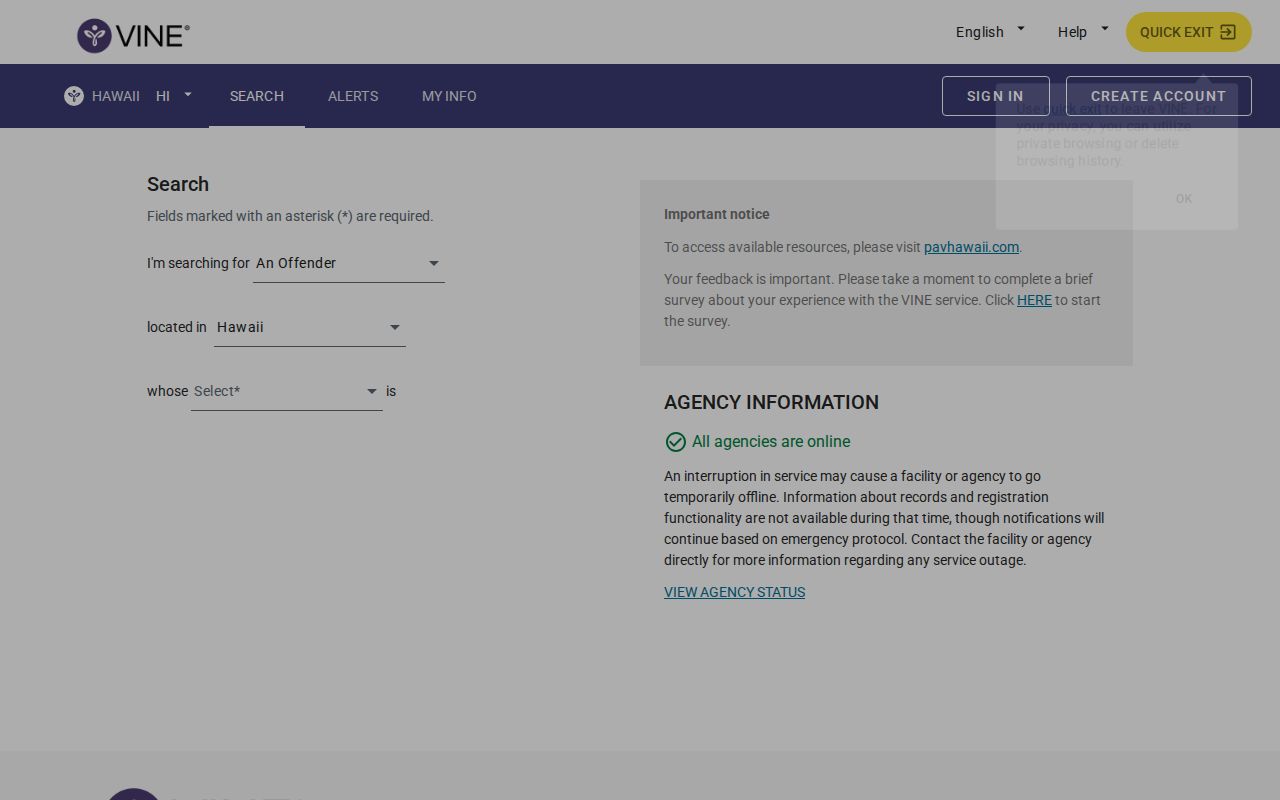
The live form helps locate the current record. It should be followed by the sentence and parole records that define the date.
- Search the named person in Hawaiʻi SAVIN/VINELink and note the literal status, agency, facility, date label, and check time.
- Read the judgment in eCourt Kōkua for the sentence structure, then obtain the court's detention-credit material if it affects the term.
- Request the HPA minimum-term order and any parole decision. Keep eligibility separate from a grant and from physical release.
- Ask DCR Offender Management or the responsible records function for the current sentence computation and tentative date of release.
- Specify that the request should identify minimum expiration, maximum expiration, presentence credit, and any recorded hold effect.
- After the anticipated day, confirm the executed departure through DCR's release or movement record.
The full DCR Offender Search route explains how to preserve a public status and request the operational release record. It is useful when a date has passed but the person has not appeared as released.
Hawaii Minimum Term and Release
HRS section 706-669 requires HPA to hold a minimum-term hearing as soon as practical and no later than six months after commitment on an indeterminate or extended term. The prisoner receives notice and may be heard. HPA then orders the minimum imprisonment that must be served before parole eligibility. The statute also calls for a verbatim record and makes the minimum-sentence guidelines public.
The minimum is not a promise of release. Under HRS section 706-670, the initial parole hearing generally occurs at least one month before the controlling minimum expires. With several terms, the key point is the minimum that expires last. HPA can grant or deny parole, and later review rules may apply after a denial. A prisoner may finish the minimum yet remain confined.
- Minimum term
- The period HPA requires before parole eligibility.
- Maximum term
- The outer term imposed by the court, subject to lawful credit and later orders.
- Parole grant
- HPA approval for conditional release, still separate from DCR's physical processing.
- Final discharge
- The end of parole authority under the governing sentence, not merely the start of parole.
A parole grant can precede release while a plan, detainer, or correctional step remains unresolved. The release-date lookup must retain all three stages: eligibility, decision, and execution.
Hawaii Good Time Release Rules
No current, generally applicable Hawaii good-time or earned-time release formula was verified in the official research. Public Safety testimony from 2011 described proposals as an effort to reestablish good time and said an administrative program would lack statutory authority under the existing minimum-term and parole structure. Later proposals cannot be treated as enacted law merely because a bill described a credit.
The rule that can be stated with confidence is HRS section 706-671. It provides credit for qualifying detention before sentence for the same crime against the minimum and maximum imprisonment terms. This is presentence-confinement credit. It is not a behavior-based award of days per month.
| Claim | Verified Hawaii rule |
|---|---|
| General good-time formula | No current statewide formula was verified. |
| Universal 85-percent rule | No authoritative source establishes it for all Hawaii state prisoners. |
| Presentence detention | Qualifying same-crime detention is credited under HRS section 706-671. |
| Parole eligibility | HPA's minimum-term order controls the threshold under the governing statutes. |
| Final date | Obtain the current DCR computation and confirm actual release after processing. |
The custodian's certificate and sentencing order are key records if detention credit is disputed. Offense-specific mandatory minimums, special parole limits, consecutive or concurrent sentences, and new court orders can all alter the result. There is no safe shortcut based on sentence length alone.
No Hawaii 85-Percent Shortcut
Hawaii's date system combines court, HPA, and DCR records. The court supplies the maximum and qualifying presentence credit. HPA fixes the minimum term. DCR performs the sentence computation and uses the internal phrase tentative date of release. The public SAVIN description does not promise that computation as a field.
Multiplying a term by 85 percent skips each of those controls. It also ignores concurrent or consecutive structure, offense-specific rules, changes to credited custody, parole decisions, detainers, and the approval of a release plan. Any result from that shortcut would be an unsupported estimate, not a Hawaii inmate projected release date.
A direct request should ask for the current computation by name. It can also seek the minimum expiration, maximum expiration, detention credit, and any recorded hold effect. Then compare the response with the HPA order and the court judgment instead of expecting one portal field to resolve the whole sentence.
Legislative proposals need the same care. A bill that would create or change sentence credit is not proof that the rule took effect. Check enacted law for the sentence and offense at issue, then use the agency's dated computation. This avoids applying a proposed formula to a person whose term is governed by a different statute, judgment, or minimum order.
Why Hawaii Release Dates Change
A tentative date can move when a source record changes or a required step has not been met. The change does not prove an error. It means the current calculation must be tied to the latest judgment, credit, parole action, and hold information. DCR policy also requires staff to check other charges and holds before an actual release.
| Factor | Possible effect | Record to check |
|---|---|---|
| Court modification or vacation | Changes the lawful term or authority for custody. | Judgment and later docket order |
| Corrected detention credit | Moves the minimum or maximum calculation. | Custodian certificate and sentencing record |
| Consecutive sentence | Pushes the controlling expiration beyond a single count. | Judgment and DCR computation |
| Parole grant or denial | Changes the path after minimum-term eligibility. | HPA decision or order |
| Conduct or incomplete program | May affect HPA's decision or release-plan readiness. | HPA record and current DCR file |
| Detainer or new case | Can block community release or move the person to another authority. | Hold record, docket, and release checklist |
| Plan not approved | Can delay a parole release after a favorable decision. | HPA and DCR release-planning records |
A transfer can also be mistaken for a release-date change. Hawaii prisoners may move among islands or to and from Saguaro Correctional Center in Arizona. A change in facility near a tentative parole date is still a custody movement unless DCR records an executed release.
Note: A detainer can end custody at one facility while sending the person directly to another lawful authority.
Request Hawaii Sentence Computation
OCCC's functional statement assigns its Inmate Records Unit responsibility for legal-document review, pre-confinement calculations, and the tentative date of release. For any state prisoner, the current DCR records contact should be confirmed before filing because routing can change. The request should be narrow, tied to a named person, and aimed at existing records.
The Hawaii OIP forms page supplies the model public-record request.

The form can be used to seek the current sentence computation and the record that states the internal tentative release date.
Identify the person, DCR number if known, facility, case number, and a useful date range. Request the current computation, HPA minimum order if DCR maintains it, maximum expiration, presentence credit, any recorded hold effect, and the record's calculation date. Ask for an electronic copy, a fee estimate, and segregable public portions if part of the file is exempt.
OIP guidance generally calls for an agency response within ten business days, though a notice or acknowledgment is not the same as completed production. Search, review, segregation, copying, and delivery fees may apply. Request a fee estimate because no single flat statewide charge can safely be assumed for every sentence file.
The annual-report index also helps keep broad correctional context dated. The official DCR publication page is shown in the captured view.
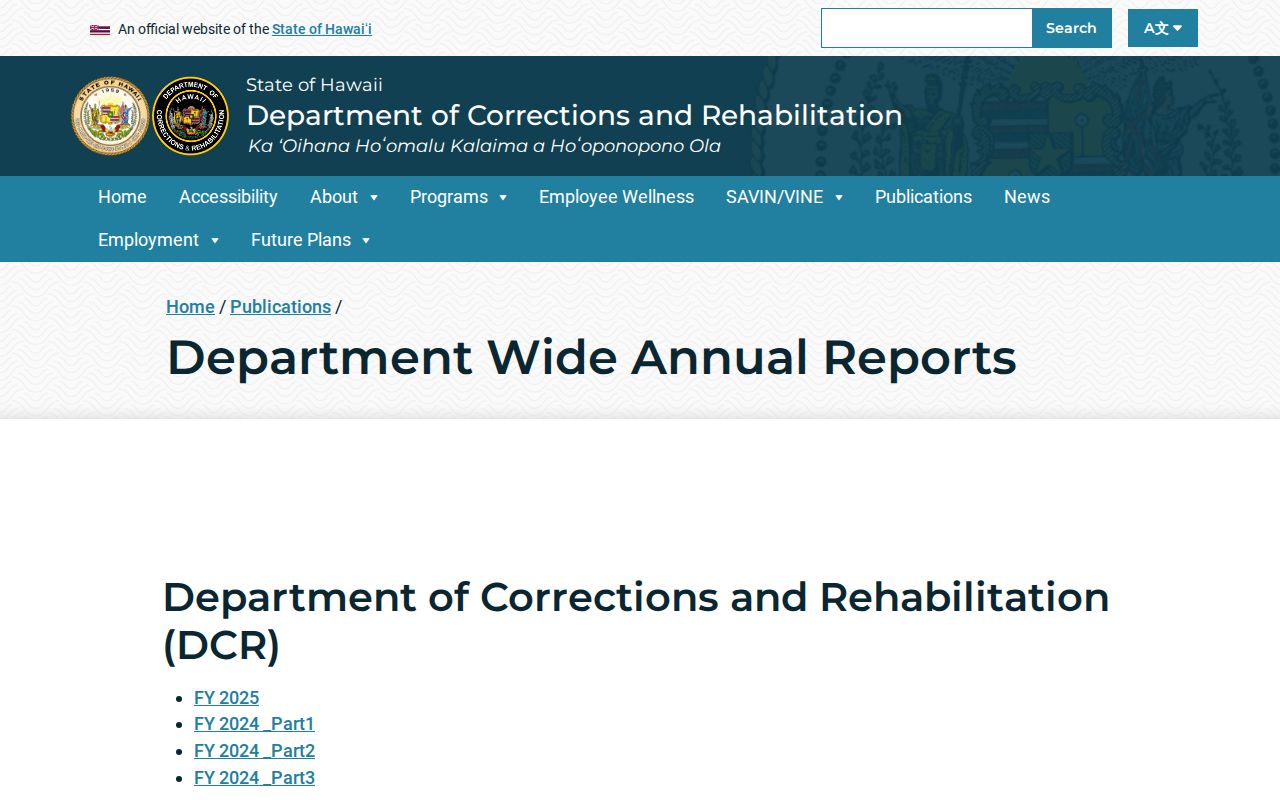
Annual reports do not replace an individual sentence computation. They document agency operations for a named fiscal year and should stay separate from a person's current date.
Confirm a Hawaii Actual Release
After an expected date arrives, check Hawaiʻi SAVIN/VINELink for the literal custody or parole event and preserve the check time. A registered notification can flag a change, but it should not be the sole proof when exact timing or destination matters. The VINE Inmate Check explains Hawaii's official DCR search and alert channel.
Then obtain the DCR release or movement record. COR.16.02 calls for identity and legal-document checks, review of other charges and holds, completion of DCR 8219, return of property and money, and an Offendertrak update. Those steps distinguish an anticipated date from an actual event.
If the person is pretrial, return to the court docket. A hearing date or bail term is not a projected sentence release. If the person is federal, the BOP locator follows federal rules. If immigration custody may follow, ICE uses its own locator. Each system answers only its part of the custody trail.